
Last Updated on October 23, 2026 by Umar Farooq
Can you lay a dehumidifier on its side? Only as a last resort for transport or storage, never while it is running, and every manual I opened asks you to stand it upright again before you switch it on. How long you wait is where the manuals disagree, and I will show you exactly where.
I would rather you never needed this page. But boots are small, vans are full and somebody always has to move the thing, so here is how to do it with the least damage to the part that costs the most to replace.

Can you lay a dehumidifier on its side to move or store it?
Keep it upright whenever you can. The manuals I read give the same instruction in different words:
- Honeywell DH45W: “Always grip the side handles and keep the unit upright when transporting from room to room. DO NOT tilt the product on its side or upside-down.” (Honeywell manual)
- Inofia: “Any time the dehumidifier is placed on its back or side, it must be allowed to stand upright for 24 hours before plugging in to avoid damage to internal components.” (Inofia manual)
- Storage: both manuals say to store the unit upright, in a dry place.
None of them says laying it down is forbidden outright. What they ask for is a wait afterwards, which tells you the risk is in switching on too soon, not in the tilt itself. That is my reading, not a manufacturer’s statement, and it is why the waiting time matters so much.
Why oil and refrigerant care which way up it is
Most portable units are compressor machines. Two manuals I opened give the reason in a sentence:
- One says to leave the unit upright for 24 hours “so the oil in the compressor can settle from the move”, and that skipping this “can affect the performance or lifespan” of the machine (manual hosted at Home Depot, brand not stated on the page).
- Honeywell asks for one hour upright before first use “to allow the refrigerant to stabilize”, and four if it travelled on its side.
So the story is oil and refrigerant that have moved while the machine was tilted, and need time to return before the compressor is asked to start. If it starts early, the compressor may run without proper lubrication. No manual puts a number on the damage and I will not invent one. The compressor is the expensive part (that is my judgement, not a quote), so the wait is cheap insurance.
How long to wait upright after it has been laid down
Here is every manual I could actually open, with the wording that matters:
| Manual | Upright wait | Condition stated |
|---|---|---|
| Honeywell DH45W | 1 hour | Before use, “to allow the refrigerant to stabilize” |
| Honeywell DH45W | 4 hours | If transported “tilted on its side or upside-down” |
| Inofia | 24 hours | Any time placed “on its back or side” |
| Two others (brand not stated) | 24 hours | Before first plug-in, as it “may have been tilted or inverted” in transit |
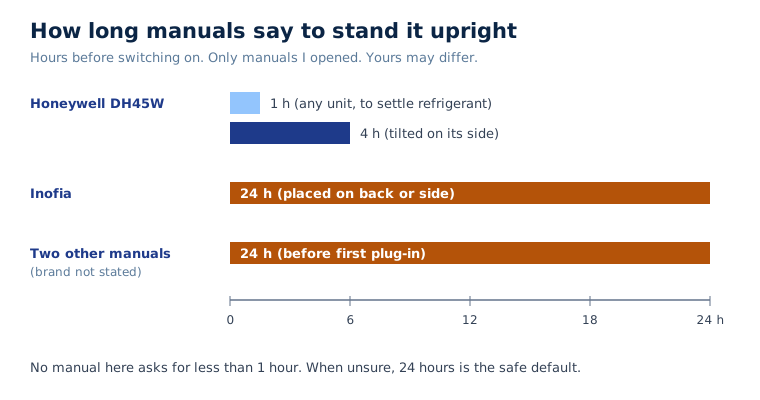
Three honest caveats. This is a sample of four, not a survey of the industry. The 24-hour manuals are written for a unit arriving in a box, though Inofia’s wording covers any time it is laid down. And some manuals are silent on all of it, in which case the wait is your call.
If yours is silent, wait 24 hours. That is a judgement, not a rule: it is the longest figure I found, it is what the stricter manuals ask for, and it costs one evening. Four hours is enough only if your own manual says so. If the unit was only tipped briefly and set straight, you are in much safer territory than if it rode in a van on its back, but I cannot give you a sourced number for “briefly”.
Drain it first, then lift
Empty the tank before you tilt, lift or carry anything. Inofia’s manual even warns not to move the unit when the full-bucket alert is showing, “in case the water spills on the floor”. An unnamed manual adds: “Do not tilt the dehumidifier while it is operating to prevent water overflow.”
Do it in this order:
- Switch off and unplug. Wait for the fan to stop.
- Empty the tank, and the drain hose if one is fitted. Honeywell’s end-of-season advice is to empty the tank and let it dry.
- Check the drain outlet or cap is closed so nothing trickles out in transit.
- Wrap the cord and secure it so it cannot swing and catch.
- Carry it by the handles, upright, keeping the tank in place.
Water left in a tank that is laid on its side goes into the carpet of the car, or into the unit’s own base. That is a second reason not to do it. The full storage routine, cleaning and drying included, is in how to store a dehumidifier, and how to clean a dehumidifier covers the filter and tank before it goes away.
If it really has to go on its side
Sometimes there is no choice. Make it the least bad version:
- Prefer a short trip to a long one. Both are laid down, but minutes are not months. The waiting time still applies.
- Choose the side the manual shows, if it shows one. None of the manuals I opened picks a side.
- Wedge it so it cannot roll, and nothing heavy sits on the grille.
- Note the time it was stood up again, and write the switch-on time on a piece of tape on the lid. Otherwise, in a week, you will not remember.
Then stand it up, plug nothing in, and wait the time your manual gives, or 24 hours if it gives none.
Desiccant dehumidifiers follow different rules
Everything above is about compressor units. A desiccant model has no compressor and no refrigerant circuit, so the oil argument does not apply in the same way. I have not opened a desiccant manual for this, so I will not tell you orientation does not matter: read yours. If you are unsure which type you have, desiccant versus compressor dehumidifiers explains how they differ.
Signs it was switched on too soon
If a unit was laid down and then run early, the typical symptom is a fan that runs while nothing is collected, or one that will not start. That does not prove the compressor is damaged, and a pause upright may fix it. Run through the fan-runs-but-compressor-doesn’t guide before assuming the worst, and check the basics in dehumidifier not turning on.
Stand it up, drain it, and give it a day
The short answer is simple. Drain it, keep it upright, and if it has been on its side, stand it up and wait the time in your manual, or 24 hours if it says nothing. The manuals I read ask for 4 to 24 hours, so the safe option is the longest of them. A day indoors is a very small price for a compressor that keeps running.
FAQ
Can you lay a dehumidifier on its back?
The Inofia manual covers it directly: any time it is placed on its back or side it must stand upright for 24 hours before plugging in. Honeywell asks for at least four hours after it travelled tilted on its side. Treat the back like the side.
How long should a dehumidifier stand upright before use?
Whatever your manual says. In the four I opened it ranged from 1 hour (Honeywell, for any unit) and 4 hours (Honeywell, after tilting) to 24 hours (Inofia and two others). If yours is silent, 24 hours is the cautious choice.
What happens if you turn on a dehumidifier that was laid down?
The manuals say the compressor oil needs time to settle and that skipping the wait can affect performance or lifespan. No manual I read says exactly what will fail, so do not expect a specific symptom.
Do you need to drain a dehumidifier before moving it?
Yes. Empty the tank and any drain hose first, unplugged. A full tank spills when carried, and a tilted unit with water in it can leak into the base or the car.
Can you transport a dehumidifier in a car boot?
Yes, upright if the boot height allows, and secured so it cannot tip. If it has to lie down, treat it as laid down: stand it up afterwards and wait before plugging in.
Does it matter if a dehumidifier is only tilted slightly?
Honeywell’s wording is “tilted on its side”, not a number of degrees, and I found no manual that gives an angle. Tip it as little as possible and, if in doubt, wait.

