
Last Updated on October 24, 2026 by Umar Farooq
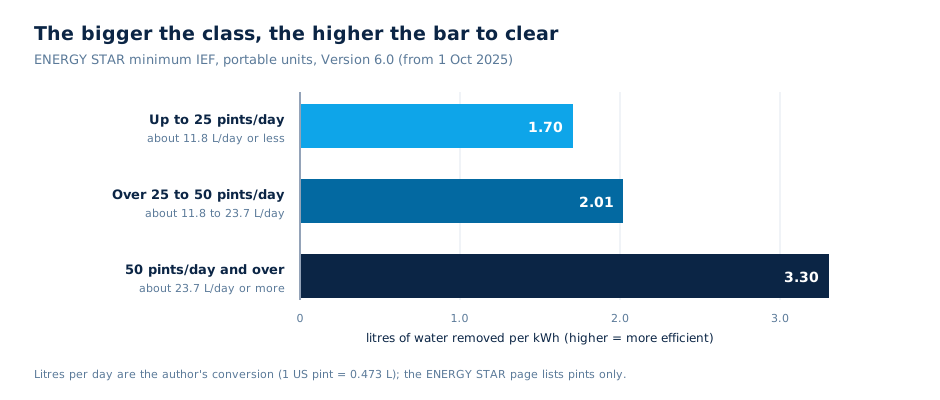
An Energy Star dehumidifier is one that removes at least a set number of litres of water per kilowatt-hour, with the minimum depending on its size class: 1.70 L/kWh at 25 pints a day or less, 2.01 up to 50, and 3.30 from 50 pints a day upwards. That is the whole of the efficiency test, and it says nothing about whether the machine suits your room.
I like the label, and I also think it gets asked to do more than it can. It is a good filter on a shortlist. It is a poor way to pick a size.
What the ENERGY STAR dehumidifier label actually certifies
ENERGY STAR is the US EPA and Department of Energy voluntary efficiency programme. Its dehumidifier overview describes certified models as “20% more efficient than non-certified models”, using better coils, compressors and fans to pull out the same moisture. That is the programme’s own claim, not something I have measured.
The measure behind the label is the Integrated Energy Factor (IEF): litres of water removed per kilowatt-hour. Higher is better, and the overview page says so in the same words.
Two other things the overview page states plainly. Every certified unit has a built-in humidistat, and the page calls 30 to 50% relative humidity the generally accepted optimum for a building. Neither is a surprise, but the humidistat is the part that stops a machine running when it has nothing left to do.
The minimum litres per kWh, by size class
The current specification is Version 6.0, effective 1 October 2025, per ENERGY STAR’s key product criteria page. For portable units there are three classes:
| Capacity class | Roughly in litres a day | Minimum IEF (L/kWh) |
|---|---|---|
| 25 pints a day or less | about 11.8 or less | 1.70 |
| Over 25, up to 50 pints a day | about 11.8 to 23.7 | 2.01 |
| 50 pints a day and over | about 23.7 or more | 3.30 |
The page lists capacity in pints only. The litre column is my own conversion at 0.473 litres to the pint.
Whole-home (ducted) units are judged by case size instead: at least 2.22 L/kWh at 8.0 cubic feet or less, and at least 3.81 above that. Most readers of this site are buying a portable, so I will stay with those.
Read the efficiency number against capacity
Here is the trap. Because the thresholds climb with size, you cannot compare IEF across classes and conclude anything. A 3.30 on a large unit is the bare minimum for that class. A 1.70 on a small one is also the bare minimum for its class.
Compare within a class, and the arithmetic is simple. Water removed divided by IEF gives electricity used. To remove 10 litres of water, a unit at 1.70 L/kWh needs about 5.9 kWh and one at 2.01 needs about 5.0 kWh. That is my own sum, not a published figure, and it works out to roughly 15% less electricity for the same water. Real rooms will not match the test, so treat it as a ratio and not a prediction.
Why not match? Both the capacity and the efficiency figure come from a fixed laboratory test, and a colder or drier room than the test point pulls less water per hour. I have no measured figure for how much, and I will not invent one. The pint ratings explainer covers the test points behind the capacity number, so I will not repeat them here.
To turn an IEF into a bill, use the sum in the dehumidifier running cost guide: watts, times hours it actually runs, divided by 1,000, times your tariff. The IEF tells you how much water each kWh buys; the hours tell you how many kWh you will use.
Energy Star versus the AHAM rating: who measures what
People talk about these as two competing ratings. They are not.
The pint figure on a box is a capacity claim: water removed in 24 hours at the test point. ENERGY STAR defines capacity the same way. The Association of Home Appliance Manufacturers (AHAM) runs an industry verification programme, and its dehumidifier procedural guide says the factor it verifies is Integrated Energy Factor, with capacity “used only to consider capacity in regards to product class”.
So the roles split like this:
- ENERGY STAR sets the efficiency pass mark, in L/kWh.
- The capacity rating (pints or litres a day) says how big the machine is, and decides which class’s pass mark applies.
- AHAM checks that the stated numbers hold up when units are tested. Its guide describes a certified capacity as valid only if the measurement lands within five per cent or 1.00 pint a day, whichever is greater.
One caveat on the AHAM document: the version I read refers to the ENERGY STAR Version 5.0 specification of 2019, so it predates the current thresholds. The structure it describes is the useful part. Check the AHAM programme directly for today’s rules.
In short, the capacity rating answers “how much water per day” and ENERGY STAR answers “how much electricity per litre”. You need both, and neither replaces the other.
What the label does not promise
The key criteria page lists efficiency thresholds and then says qualifying models must meet the full Version 6.0 document, which it does not summarise. So I can only tell you what the page confirms, and it confirms an efficiency floor and nothing about:
- Right size. The label does not know your room. Capacity is a separate decision, and the what size dehumidifier do I need guide handles it. ENERGY STAR itself says it is better to oversize than undersize.
- Low bills. Efficiency per litre means little if the machine runs round the clock on laundry mode. Hours decide most of the cost.
- Noise, drainage or features. The criteria page does not mention them.
- Refrigerant. The page does not address it. If that matters to you, the dehumidifier refrigerant guide covers R410A, R32 and R290.
- Fixing the damp. No label dries a wall that is leaking.
This is a US programme. If you are buying elsewhere, the badge may not appear at all, and the useful move is to find litres per kWh on the spec sheet and compare within the same capacity band.
Pick the size for the room first, then take the efficient one
My position: treat ENERGY STAR as a tie-breaker, not a headline. Choose the capacity for your space and dampness, then among models of that size prefer the one that carries the label or the higher IEF. A badly oversized or undersized machine wastes more than a few IEF points ever save, and that is a judgement from the running-cost sum, not a measured claim.
If the label is missing but the spec sheet shows an IEF above the minimum for its class, it is still the same test. The badge is shorthand for a number you can read yourself.
FAQ
Is an Energy Star dehumidifier worth it?
Usually, if the sizes are equal. ENERGY STAR describes certified models as 20% more efficient than non-certified ones, which lowers the electricity needed per litre. The saving still depends on how many hours the machine runs, so size and settings matter at least as much.
What is a good IEF for a dehumidifier?
A good IEF is one above the minimum for its size class: 1.70 L/kWh up to 25 pints a day, 2.01 up to 50, 3.30 at 50 and over. Compare only within a class, because the thresholds rise with capacity.
Does Energy Star mean a dehumidifier is quieter or removes more water?
No. The key product criteria page sets efficiency thresholds only. Water removal is the capacity rating, and noise is not mentioned on the page.
What is the difference between Energy Star and the AHAM rating?
ENERGY STAR sets the efficiency pass mark in litres per kWh. The capacity rating gives water removed per day. AHAM runs a verification programme whose guide says it verifies Integrated Energy Factor, with capacity used to determine the product class.
How do I check whether a dehumidifier is Energy Star certified?
Look for the ENERGY STAR mark on the box or listing, then confirm the exact model number against the certified products listed on energystar.gov. Retail listings sometimes use the badge loosely, so the model number is the thing to check.

