
Last Updated on September 1, 2026 by Umar Farooq
Buy a desiccant dehumidifier if the room drops below about 15°C. Buy a compressor unit if it stays above that. Temperature settles this argument on its own, and every other difference — running cost, noise, weight, warmth — is a secondary consideration you only get to once the temperature question is answered.
That’s the whole decision in two sentences. What follows is why, and the handful of cases where it gets more interesting.

How each one actually works
They solve the same problem with completely different physics, and once you see that the rest follows.
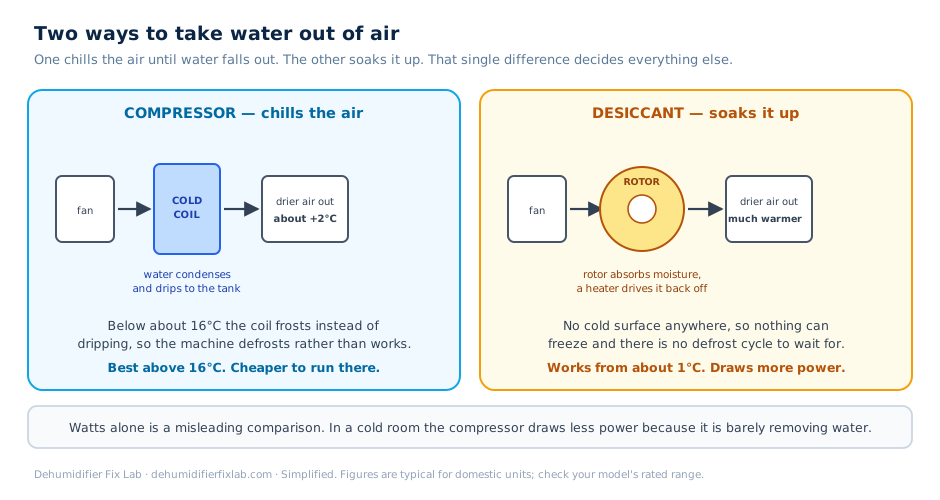
A compressor unit chills the air. A fan pulls room air over a coil kept below the dew point, water condenses onto it and drips into the tank, and the drier air comes out about 2°C warmer than it went in. It’s the same principle as a fridge, and it’s efficient — as long as the coil can stay above freezing.
A desiccant unit absorbs the water. Air passes through a slowly rotating wheel coated in a moisture-absorbing material. A small heater then drives that moisture back off the wheel in a separate airstream, where it condenses and drains to the tank. There is no cold surface anywhere in the machine.
That last sentence is the important one. No cold surface means nothing can freeze, so there’s no defrost cycle and no temperature floor to speak of.
The six differences that actually matter
| Compressor | Desiccant | |
|---|---|---|
| Working range | About 16–40°C | About 1–40°C |
| Power draw | ~150–260 W | ~250–550 W |
| Heat added to the room | Around 2°C | Noticeably more |
| Noise | Around 35–36 dB | Around 39 dB |
| Weight (similar capacity) | Heavier — around 11 kg | Lighter — around 6 kg |
| 8 kg laundry load | 4–6 hours | 2–4 hours |
Figures from published manufacturer guidance — see Sources.
1. Temperature — the one that decides it
EcoAir puts the ranges at roughly 1–40°C for desiccant and 16–40°C for compressor. Meaco’s guidance splits it three ways: below 10°C, desiccant only; 10–15°C, a large compressor or a desiccant; above 15°C, either will do.
Those agree well enough for a rule of thumb: below 15°C, desiccant. Above it, your choice.
2. Power draw — and why watts alone mislead you
A desiccant unit draws roughly double the power of a comparable compressor model. That looks damning until you ask what you’re getting for it.
The honest comparison is energy per litre of water removed, not watts. In a warm room the compressor wins that comfortably — it’s the more efficient technology and it isn’t close. But in a 5°C garage the compressor is drawing its 200 watts while collecting almost nothing, because it’s icing up and defrosting. Efficiency per litre is meaningless when the litres aren’t arriving.
So: compressor is cheaper to run where it works. That qualifier is doing a lot of work and most comparisons leave it out.
3. Heat output — and a disagreement worth flagging
Both types return their waste heat to the room. A compressor adds around 2°C.
For desiccant, the published figures disagree noticeably. EcoAir says its units put out air 3–5°C warmer; Meaco says 10–12°C. That’s a big gap, and I’d rather point it out than average two numbers that were probably measured differently.
What’s not in dispute: a desiccant unit warms a room appreciably more than a compressor one. In a cold garage that’s a genuine bonus. In a bedroom in August it’s a nuisance.
4. Noise
Close, with a slight edge to compressor units on the figures — Meaco quotes around 35–36 dB for its compressor models against 39 dB for desiccant.
The character differs more than the number. A compressor cycles on and off with an audible clunk; a desiccant unit runs at a steadier hum. For a bedroom, many people find the steady sound less disruptive than the cycling, even at slightly higher decibels.
5. Weight and portability
A desiccant unit has no compressor and no refrigerant circuit, so it’s substantially lighter — EcoAir cites a 7-litre desiccant at 6 kg against an 11 kg compressor of comparable output. If the machine is going to be carried up and down stairs, that’s not a small thing.
6. Laundry drying
Desiccant is faster. EcoAir puts an 8 kg load at 2–4 hours for desiccant against 4–6 hours for compressor, largely because the warmer output air speeds evaporation. If you’re buying mainly for drying washing indoors, that’s a real advantage.
Which desiccant dehumidifier or compressor suits which room
Buy a desiccant dehumidifier for: unheated garages, outbuildings, conservatories, boats and caravans, lofts, cold spare rooms, holiday homes left empty over winter, and anywhere you mainly want to dry laundry fast.
Buy a compressor unit for: heated living space, bedrooms, a warm basement, general year-round damp in an occupied house, and anywhere it’ll run for long hours where the lower running cost adds up.
The genuinely awkward case is a room that swings — a garage that’s 20°C in August and 4°C in January. There’s no single right answer. If you’ll mostly use it in winter, buy desiccant. If mostly summer, compressor. The full reasoning for that space is in the garage guide, and the seasonal side is covered in running one in winter.
One thing I’d push back on: buying a bigger compressor unit to cope with a cold room. Capacity isn’t the constraint — the coil still freezes at the same temperature. You’ve bought a larger machine that defrosts for the same proportion of its life.
Frequently asked questions
Is a desiccant dehumidifier better than a compressor one?
Neither is better in general. Below about 15°C the desiccant wins outright because a compressor coil frosts up. Above that, a compressor is quieter to live with and cheaper to run for the same water removed.
Does a desiccant dehumidifier use a lot of electricity?
It draws more watts — roughly 250–550 W against 150–260 W for a comparable compressor. In a warm room that makes it the more expensive option. In a cold room it’s the only one actually collecting water, so the comparison stops being meaningful.
Do desiccant dehumidifiers heat the room?
Yes, noticeably more than compressor models. Published figures range from 3–5°C to 10–12°C of temperature rise in the output air depending on whose data you read. Either way you’ll feel it.
Can I use a desiccant dehumidifier in a bedroom?
Yes. It’s slightly louder on paper but runs at a steady hum rather than cycling, which many people find easier to sleep through. Bear in mind it will warm the room.
Which is better for drying clothes?
Desiccant, on speed — roughly 2–4 hours against 4–6 for an 8 kg load, because the warmer air evaporates moisture faster. A compressor unit still does the job, just more slowly and more cheaply.
Do desiccant dehumidifiers need the filter changing?
They have a filter that needs regular cleaning like any other. The desiccant rotor itself is not a consumable in domestic units — it’s regenerated continuously by the heater as the machine runs.
What size desiccant dehumidifier do I need?
Size it the same way as any other unit — on room volume and how damp it is, not on floor area alone. The method, including the ceiling-height correction, is in the sizing guide.
Related guides: Dehumidifier in winter · Dehumidifier for garage · What size dehumidifier do I need?
Sources
- Meaco — When to buy a desiccant and when to buy a compressor dehumidifier — temperature bands, wattage, noise figures and heat output.
- EcoAir — Desiccant vs compressor dehumidifiers — operating ranges, power consumption, weights and laundry drying times.
- GE Appliances — Dehumidifier: Ideal Operating Conditions — the compressor operating limits behind the temperature rule.
Where this guide and your appliance’s own manual disagree, follow the manual. And if you’re standing in a cold garage wondering why the machine you bought last summer has stopped collecting — that’s the answer, and it’s a type problem rather than a fault.

