
Last Updated on September 1, 2026 by Umar Farooq
A dehumidifier for drying clothes works, and it works well — typically three to six hours for a normal load in a closed room, against most of a day for an airer on its own. But it only works if you shut the door, space the washing out, and give it moving air. Get those three wrong and you’ll conclude the machine is useless when the setup was the problem.
Here’s the number that makes the whole case. A single load of washing carries somewhere between 1.5 and 2.2 litres of water out of the machine. Hang it on an airer in your living room and every drop of that ends up in your air, your walls and your windows. Five loads a week is ten to twelve litres.
You are going to dry it somewhere. The question is whether the water leaves the house or stays in it.
Why indoor drying causes damp, not just dampness
This is the part worth understanding, because it explains why the machine is worth having rather than just convenient.
That two litres evaporates into the room over several hours. In a closed house in winter it has nowhere to go, so the humidity climbs — and it climbs fastest exactly when the walls are coldest.
Above 60% relative humidity, mould can establish on a suitable surface in 24 to 48 hours. And because cold surfaces sit at much higher humidity than the room reading, you can get mould in a corner while your hygrometer still looks reasonable — I’ve worked through that arithmetic in the mould guide.
So indoor drying without extraction is the most reliable way I know of to grow mould behind a wardrobe. The EPA’s position is that moisture control is the whole game, and a dehumidifier running next to an airer is moisture control at the source.
How long it actually takes
Across the guides that publish figures, the consistent picture is:
| Load | Time with a dehumidifier in a closed room |
|---|---|
| Light load, thin fabrics | 2–4 hours |
| Normal mixed load | 3–6 hours |
| Full load, towels, jeans, jumpers | Up to 12 hours |
Thick fabrics dominate the total. A load of towels holds far more water than a load of shirts and will still be damp when everything else is done — hang those on the outside of the airer where the air reaches them.
Two things stretch these times badly: a cold room and overlapped washing. Both are free to fix.
One thing worth setting expectations on: the machine does not get faster as the room dries. It gets slower. Extraction rate depends on how much water is in the air, so the first hour pulls a lot and the last hour pulls very little. That’s why the final few damp patches on a thick jumper seem to take forever — they genuinely do.
Setting the room up
This is where most of the difference lives, and it takes about a minute.
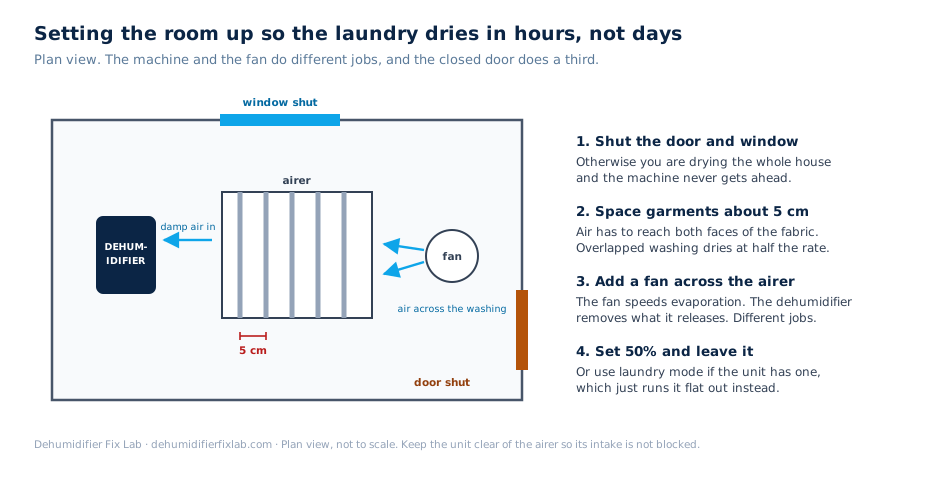
1. Shut the door and the window. A dehumidifier is in a race with air exchange. Leave the door open and you’re drying the whole house — the humid air wanders off and fresh humid air arrives, and the machine never gets ahead. One closed room is the entire trick.
2. Space the garments out. Air has to reach both faces of the fabric. Two shirts touching dry at roughly half the rate of two shirts with a gap. Five centimetres is plenty.
3. Point a fan across the airer. This is the bit that gets skipped, and it’s the cheapest improvement available. The fan and the dehumidifier do genuinely different jobs — the fan speeds evaporation off the fabric, the dehumidifier removes the vapour from the air. Neither substitutes for the other, and together they’re much faster than either alone.
4. Keep the room reasonably warm. Warmer air holds more moisture and a compressor unit works better in it. Around 18–22°C is the sweet spot. Below about 18°C / 65°F a compressor dehumidifier’s output falls away, which is why an unheated utility room disappoints.

What “laundry mode” actually does
Most units aimed at this market have a laundry or drying mode, and it’s worth knowing what it is before you pay extra for it.
It runs the compressor and fan flat out and ignores the humidistat. That’s it. Normally the machine stops when it reaches your target humidity; in laundry mode it keeps going, because the washing is still wet even if the air has hit 50%.
That’s genuinely useful — it stops the machine switching off halfway through with damp jeans still hanging. But you can get most of the way there on a standard unit by setting the target to its lowest and coming back in a few hours. Laundry mode is a convenience, not a different technology.
Some models also swing the airflow or add a fan boost. Those help. The marketing around them is usually louder than the effect.
Is it cheaper than a tumble dryer?
Yes, comfortably, on electricity. A tumble dryer heats air to evaporate water and dumps that heat; a dehumidifier recovers the latent heat as it condenses. A domestic dehumidifier typically draws a few hundred watts against a couple of thousand for a dryer.
The honest caveats:
- It’s slower. Hours, not one cycle.
- It ties up a room. You need somewhere you can shut for the afternoon.
- It’s not free. Running one for six hours a day, every day, is a real line on your bill — work it out in kWh from the rating plate rather than trusting anyone’s headline figure, including mine.
For most households without a dryer, the real comparison isn’t dehumidifier versus dryer at all. It’s dehumidifier versus hanging it up and hoping — and against that, it’s not close.
Choosing a dehumidifier for drying clothes: what size
Sizing for drying is different from sizing for ambient damp, because you’re adding a known quantity of water on purpose.
- One or two people, occasional loads: 10–12 litres/day extraction is usually enough.
- Family doing loads most days: 16–20 litres/day.
- Large household, big loads, cool house: 20–25 litres/day.
Step up a size if the room is cool or large. The general sizing method — including the ceiling-height correction that most charts skip — is in the sizing guide.
Continuous drainage matters more here than anywhere else. Drying laundry fills a tank fast, and a full tank stops the machine mid-afternoon with your washing still damp. If there’s a sink or drain nearby, run a hose and stop thinking about it.
Five mistakes that slow it right down
Overloading the airer. The instinct is to get everything on in one go. Fabric touching fabric has no airflow between it, so the middle of the pile stays wet for hours after the outside is done. Two smaller batches genuinely finish sooner than one crammed one.
Leaving the door open. Worth repeating because it’s the most common one. You are trying to hold a small volume of air at low humidity. An open door makes that volume the whole house.
Putting it in an unheated room. A cold utility room or garage is the worst place for a compressor unit — output drops sharply below about 18°C / 65°F, and near freezing it ices up and stops collecting altogether. If that’s your only option, a desiccant model is the answer.
Blocking the intake. Tucking the machine under the airer feels tidy and starves it of air. It needs clear space on its intake side, and it should never sit where drips can land on it.
Forgetting the filter. A blocked filter starves the coil, which cuts extraction quietly — you don’t get an error, you just get slower drying. Clean it monthly during the season and it stays on form.
Frequently asked questions
How long does a dehumidifier take to dry clothes?
Three to six hours for a normal load in a closed room, up to twelve for a full load of heavy fabrics. Thin items can be done in two. A fan blowing across the airer makes the biggest single difference to that number.
Should I use a fan with a dehumidifier for drying clothes?
Yes — it’s the cheapest improvement you can make. The fan speeds evaporation off the fabric; the dehumidifier removes the resulting vapour. They do different jobs and work far better together than either does alone.
Do I need to close the door?
Yes, and it matters more than the size of the machine. With the door open you’re dehumidifying the whole house while fresh humid air keeps arriving. One closed room is what makes the timings above achievable.
Is a dehumidifier cheaper than a tumble dryer?
On electricity, yes — a dehumidifier typically draws a few hundred watts against roughly two thousand for a dryer. It’s slower and it occupies a room, so the trade is time and space for running cost.
Will drying clothes indoors cause mould?
Without extraction, very likely over a winter. Each load puts one and a half to two litres of water into the air, and sustained humidity above 60% lets mould establish within 24 to 48 hours. Running a dehumidifier in the same closed room is what prevents it.
Where should I put the dehumidifier?
In the same room as the airer, a metre or so away, with its intake unobstructed. Don’t tuck it under the airer where dripping water can reach it, and don’t push it against a wall.
Can I leave it running overnight?
Yes, and for heavy loads that’s often the sensible approach — start it in the evening and the washing is done by morning. Make sure the tank can’t fill and stop the machine, or run a drain hose. A humidistat-controlled unit will cycle rather than run flat out all night.
Can I dry clothes with a desiccant dehumidifier?
Yes, and in a cold room it’s the better choice — it works down to about 1°C and gently warms the air as it runs, which helps drying. In a heated room a compressor unit is cheaper to run for the same result.
Related guides: How to dehumidify a room · What size dehumidifier do I need? · Does a dehumidifier help with mold?
Sources
- US EPA — Mold Course, Chapter 2 — moisture control at source as the basis of damp and mould control.
- ENERGY STAR — Dehumidifiers — the 30–50% relative humidity target band and capacity guidance.
- GE Appliances — Dehumidifier: Ideal Operating Conditions — the operating temperature range that governs performance in a cool utility room.
Where this guide and your appliance’s own manual disagree, follow the manual. And if you’ve been running a dehumidifier next to an airer with the door open all winter — shut the door tomorrow and see how much difference one free change makes.

