
Last Updated on September 1, 2026 by Umar Farooq
What size dehumidifier do I need? For most damp rooms under 1,000 sq ft, a 30-pint unit is the right starting point; for a damp basement of that size, step up to 50. Then adjust for ceiling height and how cold the room runs, because those two things change the answer more than square footage does.
That’s the short version. The rest of this explains the adjustments, because a chart that only knows your floor area is guessing at half the problem.
Step 1: measure, don’t estimate
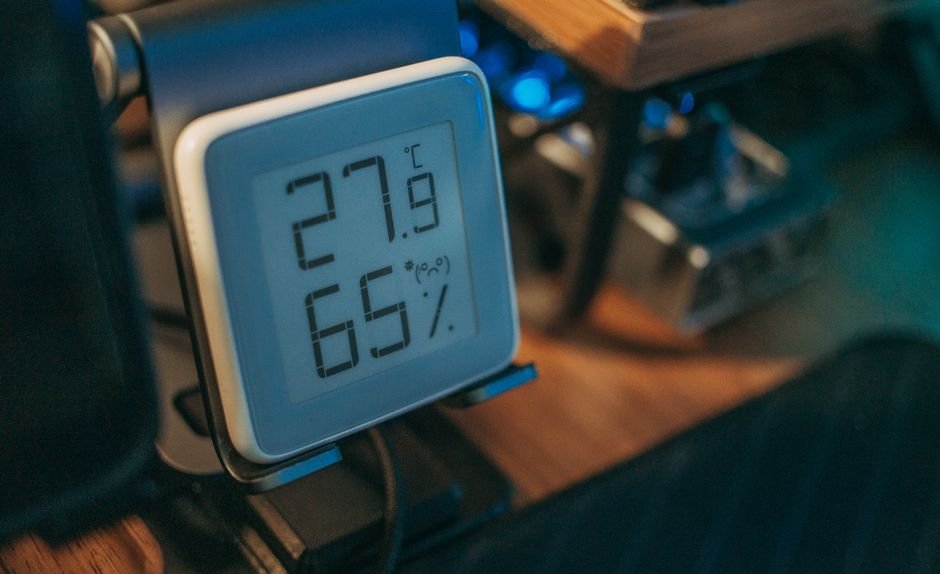
Buy a hygrometer. They cost very little and they turn this whole decision from a guess into arithmetic.
Leave it in the room for a week and read it morning and evening. You’re looking for what the humidity sits at, not what it touches after a shower. Then place yourself in one of these bands, which is the language every sizing chart uses:
| Condition | What it feels like | Reading |
|---|---|---|
| Moderately damp | Smells damp in humid weather | 50–60% |
| Very damp | Always feels damp, occasional musty smell | 60–70% |
| Wet | Damp spots on walls or floor, clear musty smell | 70–85% |
| Extremely wet | Standing water, seepage after rain | 85%+ |
If you’re in the last band, stop. That’s a water-ingress problem and a dehumidifier is the wrong first purchase. Find where it’s getting in.
Step 2: the chart
ENERGY STAR’s guidance for spaces under 2,000 sq ft is 20–30 pints/day for slightly to moderately damp, rising with the dampness band. Here’s the fuller picture in modern (post-2019) pint ratings:
| Room size | Moderately damp | Very damp | Wet |
|---|---|---|---|
| Up to 300 sq ft | 20 pints | 25 pints | 30 pints |
| 500 sq ft | 25 pints | 30 pints | 35 pints |
| 800 sq ft | 30 pints | 35 pints | 45 pints |
| 1,200 sq ft | 35 pints | 45 pints | 55 pints |
| 1,500 sq ft | 45 pints | 50 pints | 60 pints |
| 2,000+ sq ft | 50 pints | 60 pints | 70 pints |
Round up to whatever capacity is actually sold. Nobody makes a 37-pint machine.
Step 3: the two corrections that matter more than the chart
Ceiling height — because you’re drying air, not floor
Every sizing chart in existence assumes an 8-foot ceiling, and almost none of them say so. You are removing water from a volume of air, and floor area only describes that volume if the height is standard.
The fix is simple arithmetic:
Your area × (your ceiling height ÷ 8) = the effective area to look up in the chart.
A 600 sq ft room with a 10-foot ceiling is really a 750 sq ft room as far as the machine is concerned. A converted loft with a sloping ceiling averaging 6 feet is smaller than its footprint suggests.
This is the single most common sizing error I see, and it explains a lot of “I bought the size the chart said and it can’t keep up.”
Temperature — because the rating assumes a warm room
The number on the box is measured under one specific condition. Run the machine somewhere colder and it removes less water, every time. In a 12°C basement a “50-pint” unit is not a 50-pint unit.
Below about 18°C / 65°F output falls away sharply; below 5°C / 41°F a compressor unit spends its time defrosting rather than collecting, which is a symptom people mistake for a fault. For a genuinely cold space the answer isn’t a bigger compressor unit — it’s a desiccant one.
Step 4: understand what the pint number actually means
This is the part that trips people up on the second-hand market, and it’s worth two minutes.
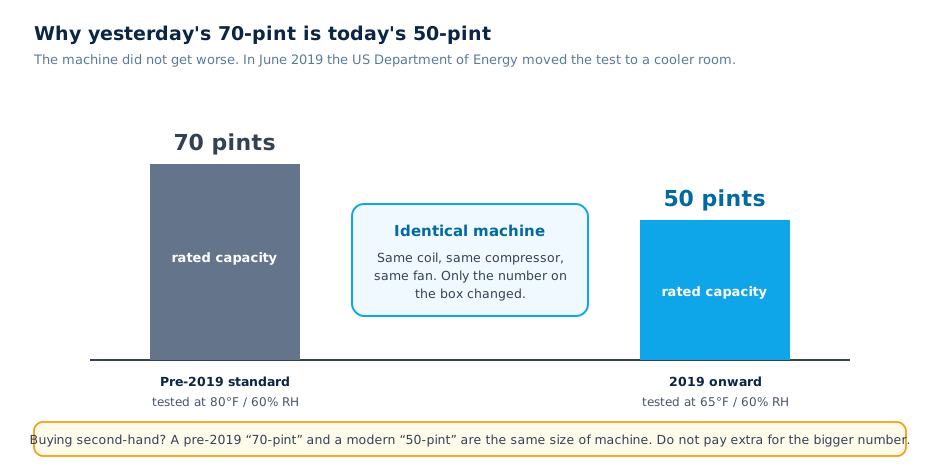
Until 2019, the US Department of Energy tested dehumidifiers at 80°F and 60% relative humidity. In June 2019 it moved the test to 65°F and 60% RH — a full 15°F cooler. Cooler air holds less water, so the same machine measures lower.
The practical result: a pre-2019 “70-pint” and a modern “50-pint” are broadly the same machine. Energy Vanguard has a good write-up of the confusion this created.
Two things follow from that:
- Don’t pay more for an old unit because the number is bigger. It isn’t a bigger machine.
- The new number is the more useful one, because 65°F is closer to what a real basement actually runs at.
What size dehumidifier do I need for an awkward space?
Three cases the charts handle badly, because they’re not really square-footage problems.
A loft conversion with sloping ceilings. Measure the average height rather than the ridge. A room with a 4-metre ridge and knee walls at 1.5 metres averages far lower than it looks, so the effective size is smaller than the footprint.
An open-plan floor. Treat it as one space and add the areas together, then site the machine centrally rather than in a corner. One correctly sized unit beats two small ones fighting each other.
A room you dry laundry in. A single load of washing releases a couple of litres of water as it dries. That is a continuous moisture source the chart knows nothing about, so step up a size and expect the machine to run hard on laundry days.
Common sizing mistakes
Undersizing to save money. An undersized unit runs continuously, never reaches your target, and costs more in electricity than the bigger one would have. This is the expensive mistake.
Wildly oversizing. Less harmful, but a very large unit in a small room short-cycles — reaching the setpoint fast, stopping, restarting. That’s harder on the compressor and doesn’t dry the room any better.
Sizing the house instead of the room. One machine can serve a floor if the internal doors stay open. It cannot serve a closed-off room two doors away.
Forgetting the basement adjustment. Basements are colder and damper than their square footage suggests. Step up one size.
Ignoring where the water comes from. A room with laundry drying in it, or a bathroom without a working extractor, has a moisture source you can size for — or remove for less money. Answering “what size dehumidifier do I need” is much easier once the source is dealt with, because you are sizing for the room rather than for the room plus a running tap.
Worked examples
A 500 sq ft bedroom, 8 ft ceiling, reads 58%. Moderately damp, standard height. 25 pints. Set it to 50% and it’ll cycle gently.
A 900 sq ft basement, 7 ft ceiling, reads 68%, sits at 15°C. Very damp, slightly low ceiling (900 × 7/8 = 790 effective sq ft), but cold. Chart says 35 pints; the cold pushes it up. Take 50 pints, and set up continuous drainage because you won’t want to empty a tank down there.
A 400 sq ft garage that drops to 4°C in winter. Chart is irrelevant. A compressor unit will ice up. Buy desiccant and size it on the room, not the season — the full reasoning is in the garage guide.
A 250 sq ft bathroom-and-landing that spikes to 80% after showers and settles at 55%. Don’t size for the spike. The average is what matters, and the real fix is an extractor fan that vents outside. 20 pints is plenty as a backstop.
Frequently asked questions
What size dehumidifier do I need for a basement?
Take the chart figure for the square footage, then step up one size. Basements run colder and damper than the number suggests, and the chart assumes neither. For most domestic basements up to about 1,200 sq ft, a 50-pint unit is the sensible default.
Is it better to oversize or undersize a dehumidifier?
Oversize, if you have to choose. An undersized unit runs permanently and never gets there. An oversized one cycles more often than ideal but does the job. Slightly over is the safer error.
How many pints do I need for 1,000 square feet?
Around 30–35 pints for a moderately damp space with a standard ceiling, 45 for very damp, more if it’s a basement or the ceiling is high.
Does ceiling height really change what size I need?
Yes, and it’s the correction most people skip. Multiply your floor area by (ceiling height ÷ 8) and look up that number instead. A 10-foot ceiling adds a quarter to the effective size of the room.
Will a bigger dehumidifier dry the room faster?
To a point, yes — more capacity means faster removal. But past the right size you’re paying for capacity that spends its life switched off, and short-cycling isn’t good for the compressor.
Can one dehumidifier do a whole house?
Sometimes, on one floor, with the internal doors open. Air needs a path between rooms. A closed bedroom at the far end of the house will hold its own humidity regardless of what’s running in the hall.
Why does my dehumidifier not collect its rated pints?
Because the rating is measured at 65°F and 60% relative humidity. Your room is probably cooler, drier, or both — and a machine in a 50% room at 15°C will collect a fraction of its label figure. That’s normal, not a fault.
Related guides: Dehumidifier drain hose: setup and the fall that works · Dehumidifier for garage: what works and what doesn’t · Does a dehumidifier help with mold?
Sources
- ENERGY STAR — Dehumidifiers — published capacity guidance by room size and dampness level.
- Energy Vanguard — The confusing world of dehumidifier capacity — the 2019 DOE test-condition change and what it did to pint ratings.
- GE Appliances — Dehumidifier: Ideal Operating Conditions — the operating temperature range that affects real-world output.
Where this guide and your appliance’s own manual disagree, follow the manual. And if you’re stood in a shop deciding between two sizes — buy the bigger one, set it to 50%, and let it cycle. That’s the mistake that costs you the least.

