
Last Updated on September 1, 2026 by Umar Farooq
Short answer: if your attic is vented, an attic dehumidifier is the wrong tool and it will never win. If your attic has been sealed and insulated at the roof line, it is often the right tool and sometimes the only one. Everything else — sizing, drainage, where to stand it — only matters after you’ve settled that one question.
I’ll be honest about which way this usually goes. Most people who search for this have a vented roof space, and the correct answer for them is to spend nothing on a dehumidifier and fix the ventilation instead. If that’s you, you’ll know within about two minutes of reading.
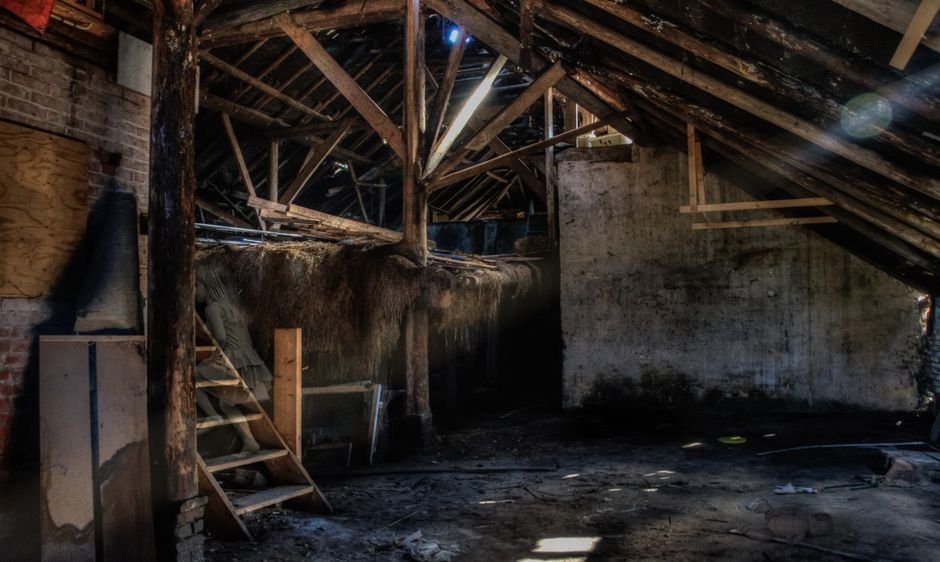
First, which attic have you actually got?
Go up there and look at where the insulation is. That’s the whole test.
Insulation lying on the attic floor, daylight visible at the eaves, a vent along the ridge — that’s a vented attic. The roof space is deliberately outside your home’s thermal envelope. Outdoor air flows in at the soffits, up under the roof, and out at the ridge, all day, every day. That airflow is the moisture control.
Insulation following the underside of the roof, no soffit or ridge vents, the space feeling roughly like the rest of the house — that’s a sealed attic (you’ll also see it called an encapsulated or conditioned attic, usually the result of spray foam). The roof space is now inside the building envelope.

Here’s the mechanism, and it’s the reason this article exists.
A dehumidifier works by pulling air across a cold coil, condensing water out of it, and returning drier air to the room. That only produces a result if the same air keeps coming back round. Put one in a vented attic and you have a machine trying to dry a volume of air that is being completely replaced with fresh outdoor air several times an hour. It is a dehumidifier with the windows open. It will run, it will collect some water, your meter will spin, and the humidity will not meaningfully drop.
In a sealed attic the opposite is true. Nothing is flushing the space any more, so whatever moisture drifts up from the house — or comes off a leaky duct — has nowhere to go. Something has to remove it, and a dehumidifier is the most direct way to do that. Building science outfits like Energy Vanguard list it as one of only four workable options for encapsulated attics, alongside supply air from the HVAC system, a small exhaust fan, and a vapour diffusion vent.
Why attic humidity is worth caring about
Not to be dramatic about it, but the attic is where your roof lives.
Sustained relative humidity above 60% is enough for mould to establish on timber in 24 to 48 hours given a suitable surface. Roof decking, rafters and the paper facing on insulation are all suitable surfaces. The EPA’s guidance is blunt on this: control the moisture and you control the mould, because you cannot win by cleaning alone.
The target band is 30–50% relative humidity, which is the same figure ENERGY STAR gives for the rest of the house. Below 30% timber and joinery start drying out and cracking; above 60% you’re on the clock. There’s no perfect number, only a band where nothing bad happens.
Signs worth taking seriously on a walk round: a musty smell, damp or blackened roof decking, rusting nail points poking through the deck, sweating ducts, compressed or sagging insulation, and frost on the underside of the roof on a cold morning.
Five checks before you buy an attic dehumidifier
Work through these in order. Three of them are free, and I reckon they resolve most of the cases that end up on this page.
1. Confirm the attic type. Vented or sealed. If vented, stop — skip to the last section. A dehumidifier is not your answer and no amount of capacity will change that.
2. Measure, don’t guess. Put a cheap hygrometer up there for a week and read it morning and evening. Attics swing enormously between night and afternoon, and a single reading tells you almost nothing. You’re looking for humidity that stays above 60% rather than spikes there briefly.
3. Find where the moisture is getting in. In a sealed attic the usual suspects are a bathroom or kitchen extractor terminating in the roof space instead of outside, unsealed loft hatches and downlights, and leaking or uninsulated ductwork sweating in humid air. Fixing a fan that vents into your own roof costs a length of duct and an afternoon. A dehumidifier that runs permanently to deal with the same fan costs you every month, forever.
4. Rule out an actual leak. A dehumidifier manages humidity. It does not fix water coming through a roof. If there’s a stain that grows after rain, that’s a roofing job, and running a machine against it is just an expensive way of postponing the repair.
5. Only then, check the machine can survive up there. This one gets skipped almost universally, and it’s the next section.
Will a normal dehumidifier even survive in an attic?
Here’s the bit the buying guides leave out.
GE’s own guidance is that a dehumidifier should be sited somewhere the temperature does not go above 90°F / 32°C. That is a fairly typical upper limit for a domestic compressor unit. Summer attics routinely run 120–150°F. So the standard portable dehumidifier you were about to carry up the ladder is being asked to work roughly 30–60 degrees outside its rated range, in a space where nobody will notice it has shut down.
Winter is the other end of the same problem. Below about 18°C / 65°F a compressor unit’s output falls away sharply, and below 5°C / 41°F frost forms on the coil faster than the defrost cycle can clear it. At that point the compressor cuts out and the fan keeps running, which looks exactly like a fault and isn’t — I’ve written up that whole symptom separately in why the fan runs but the compressor doesn’t. In an unheated attic in February, that’s not a malfunction. It’s the machine telling you it’s in the wrong room.
What this means in practice:
- Sealed, conditioned attic: temperatures stay close to house conditions, so a normal unit is fine.
- Sealed but unconditioned attic that still gets hot: you want a unit specifically rated for high-temperature operation, not a supermarket portable.
- Cold roof space in winter: a desiccant dehumidifier works down to around 1°C / 34°F because it uses a moisture-absorbing rotor instead of a cold coil. No coil, no icing, no defrost cycle.
If you do fit one, get these six things right
Drainage, not a bucket. This is non-negotiable. Nobody is going up a loft ladder every other day to empty a tank, and a full tank means the unit has stopped — often weeks before you notice. Run a hose to a gravity drain if you have the fall for it. If you don’t, that’s what an attic dehumidifier with a pump is for: it lifts condensate up and out to a drain or the outside. Bear in mind that a stuck float or a blocked hose will also stop the machine and light up a full-tank indicator on an empty tank, which is its own diagnostic rabbit hole.
Freeze protection on the drain. A condensate line running through a cold roof space in winter will freeze, back up, and overflow into your insulation. Insulate it, or route it somewhere warm.
Size for the volume, not the floor area. Attic ceilings slope, so floor area overstates the space. Work out roughly cubic metres or cubic feet and buy on that. Bear in mind that pint ratings are not comparable across model years — the US Department of Energy changed the test conditions in 2019, so a modern 50-pint unit removes roughly what a pre-2019 70-pint one did. If you’re comparing a second-hand bargain against a new machine, that’s the catch.
Give it air on all sides. At least 30 cm / 12 inches clear, and don’t shove it against insulation where it will re-breathe its own exhaust and choke the intake.
Sort out power properly. A permanent attic dehumidifier wants a proper fixed socket, not an extension lead snaking up through the hatch. Compressor start-up current is high, and a long thin lead drops enough voltage to cause repeated failed starts.
Make it reachable. Filters still need cleaning monthly-ish, and a machine you cannot reach is a machine you will not maintain. Put it near the hatch, on a solid board, raised off the joists.
A humidistat-controlled unit set to around 50% will cycle rather than run flat out, which is both cheaper and kinder to the machine. Set it and leave it — chasing 35% in a roof space is a waste of electricity.
If your attic is vented, here’s what to do instead
This is the answer for most people reading, so it gets its own section rather than a footnote.
- Clear the soffit vents. They get blocked by insulation pushed too far into the eaves more often than anything else. Baffles keep the gap open. This is often the entire fix.
- Check the ridge vent is actually open and not clogged or paint-sealed.
- Get the extractor fans outside. A bathroom fan discharging into the roof space is the single most common source of attic moisture I come across, and it is a cheap fix.
- Seal the leaks from below. Loft hatch, downlights, service penetrations, the gap around the soil pipe. Warm damp house air rising into a cold attic is what condenses on your roof deck.
- Insulate the ducts so they stop sweating.
None of that involves buying a dehumidifier, and all of it treats the cause instead of the symptom. If you’ve done every one of those and the humidity is still above 60% for weeks at a time, then you have an unusual roof space and it’s worth getting someone to look at it properly.
Frequently asked questions
Is a dehumidifier good for an attic?
In a sealed or encapsulated attic, yes — it’s one of the few things that works. In a vented attic, no. The space is deliberately open to outside air, so the machine is trying to dehumidify the outdoors and will run indefinitely without winning.
How do I reduce humidity in my attic?
In a vented attic: clear the soffit vents, confirm the ridge vent is open, make sure no extractor fan is discharging into the roof space, and air-seal the loft hatch and downlights. In a sealed attic: find and fix the moisture source first, then add a dehumidifier, supply air from the HVAC system, or a vapour diffusion vent.
What humidity should an attic be?
Aim for the same 30–50% band recommended for the rest of the house (ENERGY STAR). Brief spikes are normal; sustained readings above 60% are what put timber at risk.
Do I need an attic dehumidifier after spray foam?
Often, yes. Spray foaming the roof line turns the attic into part of the conditioned house, and once the vents are gone there’s nothing flushing the space. A dehumidifier is one of the standard options — but check whether supply air from your HVAC system can do the job first, since it may cost nothing extra.
Where should a dehumidifier be placed in an attic?
Near the hatch so you can reach it, raised off the joists on a solid board, with at least 30 cm / 12 inches of clearance all round and away from insulation that could block the intake. Somewhere the drain hose can fall towards an outlet, or where a pump can be fitted.
Can I leave a dehumidifier in the attic over winter?
Only if the space stays above about 5°C / 41°F, or if it’s a desiccant unit. A compressor model in a freezing roof space will ice up, run fan-only, and achieve nothing — and any water in the tank or drain line can freeze and split it.
Is a permanent attic dehumidifier worth it?
In a sealed attic with a genuine ongoing moisture load, yes — the alternative is roof decking damage that costs far more. In a vented attic it’s a permanent electricity bill in exchange for nothing.
Related guides: Dehumidifier fan runs but the compressor doesn’t · Dehumidifier says the bucket is full when it’s empty
Sources
- ENERGY STAR — Dehumidifiers — the 30–50% relative humidity band and current sizing guidance.
- GE Appliances — Dehumidifier: Ideal Operating Conditions — the recommendation not to site a unit where temperatures exceed 90°F.
- Energy Vanguard — Four ways to control humidity in an encapsulated attic — dehumidification as one of the workable options for sealed roof spaces.
- US EPA — Mold Course, Chapter 2 — moisture control as the basis of mould control.
Where this guide and your appliance’s own manual disagree, follow the manual. And if you’ve already carried a dehumidifier up the loft ladder before reading this — go and look at where the insulation is. It’s a two-minute job and it might save you carrying it back down.

