
Last Updated on October 25, 2026 by Umar Farooq
How to stop condensation in a metal shed: put a vapour barrier under the floor, vent the air high on opposite walls, insulate the underside of the roof, and stop carrying wet or warm things inside. You will not get it to zero, but you can get it from raining indoors to a faint mist on a cold morning.
A steel shed is a very good condenser. If you set out to build a device for turning garden air into drips on your lawnmower you would struggle to beat it.

Why steel sheds drip when wooden ones only feel damp
Metal conducts heat. On a cold night the roof panels fall to the outside temperature within the hour, and the warmer, damper air inside the shed meets that surface. Once the panel is below the air’s dew point, water forms on it and runs down the walls or drips onto your tools.
A timber shed has a bit of buffer: wood takes up some of the moisture and is not as cold on its inner face. A metal shed has none of that, and many are sold with a thin or missing floor and few vents. That is the whole design, and it explains the fix list that follows.
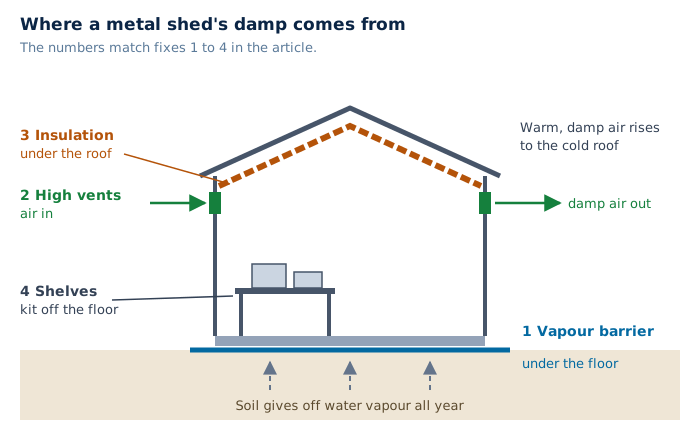
Fix 1: stop the ground feeding the air
The ground gives off water vapour all the time. Tim Carter of Ask the Builder, answering a reader with a new metal shed, says the biggest source of the problem is water vapour rising from the soil, which should be blocked with a laminated vapour barrier or closed-cell rigid foam. His preference is a concrete slab with a vapour barrier underneath, and if you use cheap home-centre sheeting he suggests two or three layers.
In practice that means:
- Put sheeting under the base or slab, lapped generously at the joins.
- Raise the shed off bare soil on a firm base, so the floor is not in contact with wet ground.
- Seal any gap between the shed bottom rail and the base.
Fix 2: vent high, on opposite walls
A sealed steel box holds the moisture in. A couple of vents let it out.
Put one vent high on one wall and another high on the opposite wall, so air can cross the shed. Warm, damp air collects near the roof, so that is where the exit should be. This is my reasoning and not a researched figure for vent size, so follow the maker’s guidance if the shed came with vents.
Ventilation only helps when the air outside holds less water than the air inside. On a mild, muggy day it brings damp air in. How to keep a shed dry has the full rule and the wider fixes, and the same logic is used in condensation in a garage.
Fix 3: insulate the underside of the roof
The drips come from the roof panels, because they are the coldest, largest surface. Insulating the underside keeps the inner face warmer, which keeps it above the dew point for longer.
The principle is the one the EPA gives for cold pipes: cover cold surfaces with insulation so moisture has no cold surface to settle on. Rigid insulation boards fixed to the underside of the roof, or a lining behind a small air gap, will do it. Do it on its own and you will help, not cure: Carter says condensation cannot be fully eliminated, only mostly controlled, and I agree with that. Insulation plus a sealed floor plus vents is the combination that works.
Fix 4: watch what you bring in
A big, warm engine or a wet tarp is a moisture delivery. A cold floor and walls will do the rest.
- Let a mower, bike or motorbike cool down before you put it away, and wipe it dry.
- Do not store wet tents, towels or tools. Dry them in the house first.
- Keep things on shelves off the floor, and away from the metal walls.
- Check that the door seals shut so the rain does not come in by the side.
Fix 5: handle what is left with absorbers or a small heater
After the four above, the leftover moisture is manageable. A moisture absorber is a sensible shed-sized backup: see do moisture absorbers work for their real capacity. A powered dehumidifier needs electrics in the shed, so treat that as a separate safety job for a qualified person.
Where is the water coming from? A quick test
| What you see | Likely source |
|---|---|
| Drips from the roof on a dry day | Condensation on the cold panels |
| Damp floor, rust at the bottom edge | Ground moisture or no floor barrier |
| Wet only after rain, at a seam or screw | A leak at a joint or a missing washer |
| Misted windows or walls, no drips | Humid air, ventilation needed |
If it only happens after rain, check the seams and the screw washers first. That is a leak and no vapour barrier will fix it.
How to stop condensation in a metal shed: seal the floor, vent high, insulate the lid
That is how to stop condensation in a metal shed: reduce the vapour coming up, let the damp air out where it collects, keep the roof warmer, and be careful what you carry in. Do those in that order and the daily rain indoors turns into an occasional mist.
FAQ
Why does my metal shed have so much condensation?
Metal drops to the outside temperature quickly, so the inner roof and walls are often below the dew point of the shed air. Add ground vapour and wet items and water forms on the panels.
Will insulation stop condensation in a metal shed?
It helps by keeping the inner surface warmer, but it does not remove the moisture. Combine it with a floor vapour barrier and vents.
Should a metal shed have ventilation?
Yes. A sealed steel box traps moisture, so a vent high on two opposite walls gives the damp air a way out. Keep it open only when the outside air is drier than the air inside.
Does a metal shed need a concrete base?
It needs a firm, dry base with a moisture barrier. A slab with a barrier under it is the option Ask the Builder prefers, though a raised firm base with sheeting is a cheaper alternative.
Can I use a dehumidifier in a metal shed?
You can, but it needs a safe power supply and works poorly when it is very cold. Fix the floor, vents and insulation first, and treat electrics in a shed as a job for a qualified person.

