
Last Updated on October 24, 2026 by Umar Farooq
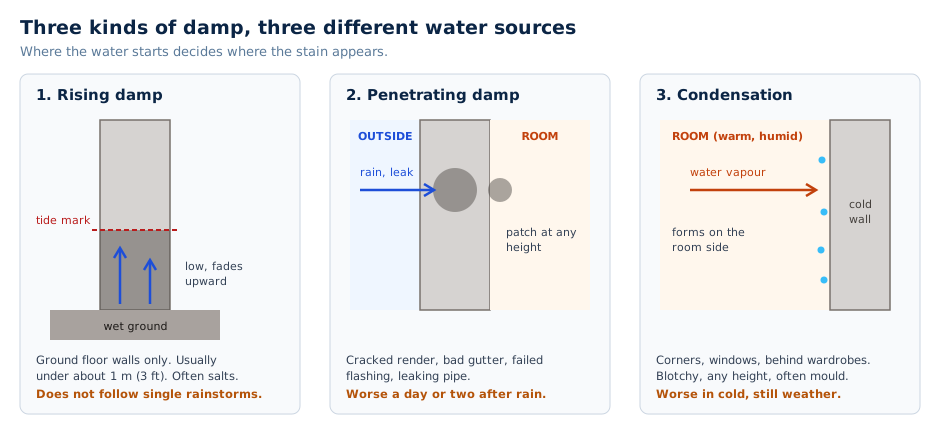
What is rising damp? It is groundwater drawn up through a wall’s masonry by capillary action, leaving a damp band low on ground-floor walls, often with a tide mark and salt deposits above it. It is also much rarer than the word “damp” suggests, because most stains on most walls are something else.
The message arrives every time the weather turns: “I have damp on my bedroom wall, is it rising damp?” It almost never is. Usually it is a first-floor wall, in a cold corner, behind a wardrobe, in January. Rising damp has never climbed a staircase.

What is rising damp? Ground water in the wall, and it stays low
Bricks, stone and mortar are full of tiny pores. If the base of a wall sits in wet ground and nothing blocks the way, water creeps up through those pores. The Society for the Protection of Ancient Buildings (SPAB) says moisture can climb 900 mm (about 3 ft) or more, depending on the masonry, the water table and how quickly the wall can evaporate it. The Property Care Association, a trade body, describes the same mechanism.
Three signs point to it:
- the damp is on ground-floor walls (or in a basement), strongest at the bottom and fading as you go up;
- there is often a roughly level tide mark, with salt crystals or a white powder around it;
- it does not switch on and off with a single rainstorm.
Raised garden soil, a patio built over the old damp-proof course, or a failed or missing one are the usual culprits. The first two are things you can see from outside with your own eyes.
Penetrating damp comes sideways, from outside
Penetrating damp is rain or leaking water getting through the building envelope: cracked render, a blocked gutter spilling down the wall, a failed window seal or flashing, a leaking pipe. The gov.uk guidance on damp and mould defines it as water that gets into the building from outside through defects in the walls, roofs, windows or floors.
The giveaway is that it follows a defect, not the floor. A patch with irregular edges on an upper wall, a stain on a ceiling under a roof valley, or a patch that darkens a day or two after heavy rain all say “water is getting in here”. SPAB adds that rain penetration often shows as green staining on the outside face, so walk round and look up.
Condensation is the one you probably have
Condensation is not water entering the building at all. It is moisture already in your air, from breathing, showering, cooking and drying laundry, landing on a surface cold enough to make it drop out. The same gov.uk guidance calls it the most common type of damp and says inadequate ventilation makes it more likely.
It turns up in corners, on and around windows, behind wardrobes and along north-facing external walls, usually in blotches, often with black spotting, and it is worse in cold, still weather. For the full mechanism, see condensation on walls and ceilings.
Which damp is it? Compare the clues side by side
| Clue | Rising damp | Penetrating damp | Condensation |
|---|---|---|---|
| Where | Ground-floor or basement walls, low | Anywhere, level with a defect outside or above | Cold spots: corners, windows, behind furniture |
| Shape | Band fading upward, tide mark | Irregular patch with a defined edge | Blotchy, often speckled with mould |
| Weather link | Little change with one storm | Worse after rain | Worse in cold, still, humid weather |
| Salts or white powder | Common | Sometimes | Rare |
| Cure | Cut off the ground water | Fix the leak or defect | Cut moisture, add heat and ventilation |
Four cheap checks to run before you ring anyone
Do not poke at, drill into or sand a wall near electrics, and wear a dust mask if you disturb mouldy plaster. Switch off the power to a socket that is wet or on a visibly soaking wall before you go near it.
- Map it. Photograph the stain with a tape measure beside it. Mark the edge in pencil and check again in a week. Height and shape do most of the diagnosis.
- Try the foil test. Tape a square of kitchen foil tight against the wall, seal all four edges, and leave it for a day or two. Water on the room side of the foil means condensation. A dry foil and a dark wall behind it means the water is coming through the wall.
- Read the room, not the wall. A cheap hygrometer (a few pounds) shows relative humidity. The EPA advises keeping indoor humidity below 60 percent, ideally 30 to 50 percent. Persistently higher than that points to condensation.
- Walk the outside. Look at the gutters, downpipes, render, the soil level against the wall and any planting. Anything bridging the damp-proof course, or dumping rain onto the wall, is a candidate.
I would not trust a handheld “damp meter” on its own. SPAB warns that salts in a wall can push electrical meters high even when the wall is not especially wet, which is how dry walls get misdiagnosed. Use the meter as a pointer, not a verdict.
Stop guessing and call an independent surveyor in these cases
Call a chartered building surveyor if the stain is low and banded with a tide mark and salts on a ground-floor wall, if it follows rain and you cannot see the source, or if the building is old, solid-walled or listed. Ask for a diagnosis and a written report, not a quote for work. SPAB advises a second opinion from an independent chartered surveyor or consultant rather than a contractor, and I agree: the person diagnosing should not be the person billing.
If you are not in one of those cases, you probably do not need one. A stain high on a wall that passes the foil test and shows high humidity is a ventilation and heating problem. A dehumidifier helps there: choose one by what size dehumidifier you need, and run it while you fix the cause. Lowering humidity in the house covers the habits that do most of the work.
Name the water source and the stain stops being a mystery
Rising damp is ground water, penetrating damp is outside water and condensation is your own water. Each has a different source and a different fix, and painting over the wrong one only hides it for a season. Work out which one you have using the shape of the stain, the foil patch and a humidity reading, and if the clues point to the ground or the roof, get an independent opinion before spending money. If they point to your own air, the cure is usually cheaper and sits in your own hands.
FAQ
What causes rising damp?
Groundwater travels up through the masonry by capillary action when the wall has no working damp-proof barrier or the barrier is bridged, for example by soil or a patio built up against the wall. It is usually seen in older buildings.
How high does rising damp go?
SPAB says moisture can reach 900 mm or more depending on the masonry, the water table and evaporation. Damp well above that on a ground-floor wall is worth checking for penetrating damp or a leak as well.
Can rising damp happen upstairs?
No. It is ground water, so it only affects walls and floors in contact with the ground. Damp on an upper floor is penetrating damp, a plumbing leak or condensation.
Is rising damp or condensation more common?
Condensation. The gov.uk damp and mould guidance describes it as the most common type of damp in homes. True rising damp is rarer than people assume, which is why it is so often misdiagnosed.
How can I tell condensation from penetrating damp?
Condensation appears on cold surfaces and is worst in cold, still weather, with water on the room side of the surface. Penetrating damp follows rain and sits level with a defect outside. The foil patch test helps tell them apart.

