
Last Updated on September 1, 2026 by Umar Farooq
Does a dehumidifier help with mold? Yes — but only with the mold you haven’t got yet. It lowers the humidity that mould needs to germinate, which stops new growth and slows what’s already established. It does not kill spores, it does not clean a patch off a wall, and it will not win against a leak.
That’s the honest version, and it’s worth knowing before you spend anything, because a dehumidifier bought to solve visible mould is usually the wrong purchase in the wrong order.
Two notes before we start. I use “mould” throughout because that’s how I spell it; it’s the same thing as mold. And there’s one mechanism in here that explains almost every “but my hygrometer says 50%” email I get.
What a dehumidifier actually does about mould
A dehumidifier pulls room air across a cold coil, condenses water out of it, and sends drier air back. That’s it. There is no biocide, no filter that captures mould, nothing that reaches a colony living in plaster.
What it changes is the condition. Mould spores are always in the air, indoors and out — you cannot remove them and you don’t need to. What they need to become mould is moisture on a surface for long enough. Take the moisture away and they stay dormant.
So the honest framing is:
- Prevents new growth: yes, reliably, if you hold the humidity down.
- Slows existing growth: yes, by drying it out.
- Kills existing mould: no.
- Removes the stain or the smell: no.
- Fixes a leak or rising damp: absolutely not.
The EPA is direct about this: control the moisture and you control the mould. It is the only durable answer, and it is why “dehumidifier plus fix the source” works and “dehumidifier alone” often doesn’t.
Why mould grows when your hygrometer says 50%
Here is the bit almost nobody explains, and it resolves most of the confusion.
Mould doesn’t respond to your room’s humidity. It responds to the humidity at the surface it’s sitting on. Those are different numbers, and on a cold wall they can be wildly different.
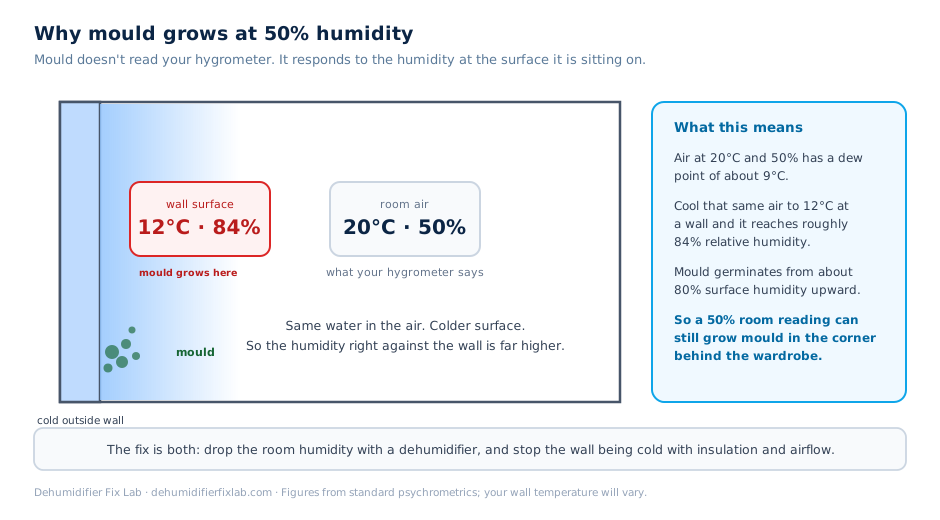
Work it through. Air at 20°C and 50% relative humidity has a dew point of about 9°C. Now let that same air touch an external wall whose surface sits at 12°C — perfectly normal for an uninsulated wall in winter. The air hasn’t gained any water, but because it’s colder against that surface, its relative humidity climbs to roughly 84%.
Mould germinates from around 80% surface humidity upward. So a room reading a comfortable 50% can still be growing mould in the corner behind the wardrobe, and your hygrometer will never tell you.
This is why the answer to mould is almost always two things at once: bring the room humidity down, and stop the surface being cold. Insulation, airflow behind furniture, and not blocking radiators do the second job. A dehumidifier only does the first.
The numbers worth holding onto
- 30–50% relative humidity is the band to aim for, the same figure ENERGY STAR gives for general indoor air. Below 30% timber and joinery start cracking.
- Above 60% RH, mould can establish on a suitable surface in 24 to 48 hours.
- Around 80% surface humidity is where germination begins — which, as above, can happen with the room at 50%.
- 10 square feet is the EPA’s threshold for doing it yourself, and it matters. More on that below.
Set the machine to 50% and leave it there. Chasing 35% costs electricity and buys you nothing extra against mould.
When a dehumidifier is genuinely the right answer
- Condensation-driven damp. Steamy bathrooms, kitchens, drying laundry indoors, a bedroom with the window shut. The moisture is coming from inside and a dehumidifier removes it directly.
- A basement or cellar that is dry underfoot but stuffy and smells musty.
- Storage spaces — wardrobes, garages, lofts — where the goal is to protect what’s in there.
- After a spill or a leak that has been fixed, to dry the fabric of the building out.
- As permanent insurance in a house that just runs humid.
In all of those the water is arriving as vapour, and vapour is what a dehumidifier is for.
When it is the wrong answer
- There’s an actual leak. A failed gutter, a cracked render, a slipped tile, a leaking pipe. The machine will run continuously, cost you a fortune, and never win. Find the water first.
- Rising damp or a failed damp course. Same problem: a source that replenishes faster than you can remove.
- The mould is already extensive. Drying it doesn’t remove it. Dormant mould still stains, still smells, and still contains the material people react to.
- You bought it instead of ventilating. In a lot of houses an extractor fan that actually vents outside does more for less money.
My honest position: if you can see mould and you haven’t yet worked out where the water is coming from, a dehumidifier is the second purchase, not the first. Spend the first hour finding the source. That hour is free.
Getting rid of what’s already there
A dehumidifier won’t do this, so here’s the boundary clearly drawn.
The EPA’s guidance is the cleanest threshold I know of: “If the moldy area is less than about 10 square feet (less than roughly a 3 ft. by 3 ft. patch), in most cases, you can handle the job yourself.”
Under that, and on a hard surface, it’s scrub with detergent and water and dry thoroughly. Porous materials that have been colonised — carpet, ceiling tiles, plasterboard — usually need replacing rather than cleaning, because you cannot get it out of the pores.
Over 10 square feet, or if it keeps returning, or if anyone in the house has asthma or is immunocompromised, that’s a professional job and outside what this site covers. I write about appliances; remediation is a different trade and I’d rather point you at it than pretend otherwise.
One thing worth knowing: you don’t need to kill mould, you need to remove it. Dead mould still causes the same reactions. That’s why the EPA talks about cleanup rather than disinfection.
Setting one up so it actually helps
- Size it for the volume, and put it in the room with the problem rather than the hallway.
- Set 50% and leave it running on the humidistat. Short bursts achieve nothing; humidity re-equilibrates within hours.
- Pull furniture 5–10 cm off external walls. Air movement behind a wardrobe raises the surface temperature and drops the surface humidity. This is free and it works.
- Sort out drainage if it’ll be running unattended — see the drain hose guide. A full tank stops the machine and you won’t notice for days.
- Clean the filter monthly. A blocked filter starves the coil and the machine quietly stops collecting.
- Don’t put it in an unheated space in winter and expect results — below about 5°C / 41°F a compressor unit ices up and runs fan-only, which is a separate symptom entirely.
Dehumidifier or ventilation first?
This is the question I get asked most, and the answer isn’t the same for everyone.
Ventilation moves moist air out and replaces it with outdoor air. That works brilliantly when the outdoor air is drier than yours — a crisp winter day, most of the year in a cold climate. It costs nothing to run beyond the heat you lose.
A dehumidifier removes water without exchanging air. That works when the outdoor air is no drier than yours — a muggy summer, a coastal climate, a basement below ground where there’s no useful outside to open to.
So the honest rule of thumb: if opening a window makes the room feel drier, ventilate. If it makes it feel muggier, dehumidify. In most homes the real answer is both, at different times of year.
Where ventilation wins outright is at the source. An extractor fan that genuinely vents outside — not into a loft — removes bathroom and kitchen moisture before it ever reaches a cold wall. That is cheaper and more effective than any amount of dehumidifying downstream of it.
So, does a dehumidifier help with mold in the end?
Yes, on one condition: that it is doing the job it’s actually capable of.
It is a moisture-removal machine, and mould is a moisture problem. Point it at humid air and it wins. Point it at a leak, a cold uninsulated wall, or a patch of mould already growing on the plaster, and it will run for months without changing anything you can see.
Get the source fixed, get the surface warmer, then let the machine hold the room at 50%. That combination works. Any one of the three on its own usually doesn’t.
Frequently asked questions
Does a dehumidifier kill mold?
No. It removes the moisture mould needs to grow, which stops new growth and dries out existing patches, but it has no effect on the spores themselves. Existing mould has to be physically removed.
Will a dehumidifier get rid of the musty smell?
Partly, and slowly. The smell comes from compounds the mould releases while it’s actively growing, so drying the space reduces it. If the source material is still there — colonised carpet underlay, damp plasterboard — the smell comes back whenever conditions allow.
Is a dehumidifier or an air purifier better for mold?
They do different jobs. A dehumidifier removes the moisture that lets mould grow. An air purifier with a HEPA filter captures spores already airborne. If you’re choosing one, the dehumidifier addresses the cause; the purifier addresses a symptom.
What humidity level stops mold?
Keep the room between 30% and 50%. Above 60% mould can establish within 24–48 hours. Remember that cold surfaces can sit far higher than the room reading, so 50% is a target rather than a guarantee.
Can a dehumidifier make mold worse?
Not directly, but a neglected one can contribute. If the tank sits full of standing water, or the filter and coil are never cleaned, the machine itself grows biofilm and can push a musty smell around the room.
How long does it take to work?
Hours to drop the air humidity, days to dry out the fabric of a room, and weeks before damp plaster and timber reach equilibrium. Judge it after a fortnight of continuous running, not overnight.
Does a dehumidifier help with mold in a basement?
More than almost anywhere else. Basements are below ground, so opening a window rarely brings drier air in, and the walls and slab stay cold year round. That combination — humid air, cold surfaces, no useful ventilation — is exactly what a dehumidifier is built for.
Do I need a dehumidifier in every room?
Usually not. Air moves between rooms, so one appropriately sized unit with internal doors left open often holds a whole floor. Rooms that are shut off and colder than the rest — a spare bedroom, a garage — may need their own.
Related guides: Dehumidifier drain hose: setup and the fall that works · Dehumidifier for garage: what works and what doesn’t · Attic dehumidifiers: do you need one?
Sources
- US EPA — Mold Course, Chapter 2 — moisture control as the basis of mould control.
- US EPA — Mold Cleanup in Your Home — the 10 square feet threshold for handling it yourself.
- ENERGY STAR — Dehumidifiers — the 30–50% relative humidity band.
Where this guide and your appliance’s own manual disagree, follow the manual. And if you’re standing in front of a patch of mould with a new dehumidifier still in its box — put the box down for an hour and go and find where the water is getting in. The machine will still be there afterwards.

