
Last Updated on September 1, 2026 by Umar Farooq
A dehumidifier for garage use fails for one of two reasons, and neither of them is the machine. Either the garage is too cold for a compressor unit, or the door opens often enough to swap the air out faster than the machine can dry it. Sort those two out and an ordinary portable will keep a garage at 50% all summer. Ignore them and you will buy a bigger unit, and then a bigger one after that.
I’ll be straight about the odds. If your garage is unheated and detached, a standard compressor dehumidifier is going to disappoint you from about October onwards, and no amount of pint capacity changes that. The fix is a different type of machine, not a bigger one.
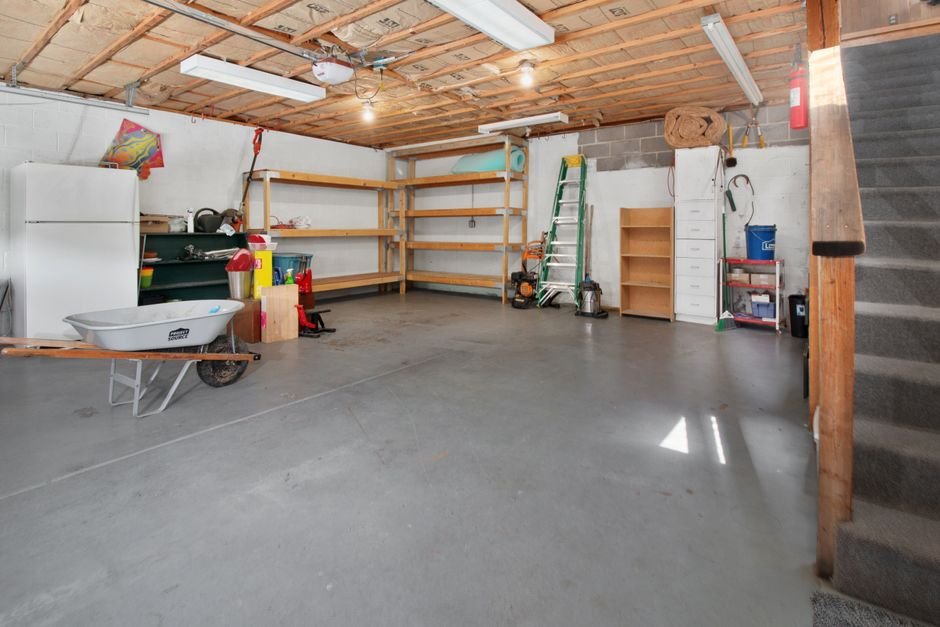
Why garages get damp in the first place
A garage is the worst-behaved room in the house, and it’s worth understanding why before you spend anything.
The slab is cold and it never really warms up. Concrete sitting on ground stays close to soil temperature year round. Warm humid air meets it, hits its dew point, and condenses — which is why you get a wet floor on a mild morning with no leak anywhere.
There’s usually no insulation and no heating, so the air temperature swings hard between day and night. Every swing pushes air past its dew point somewhere.
A car brings water in. Rain and snow on paintwork and tyres evaporates into a closed space overnight. A single wet car can put litres of water into the air.
And the door is enormous. Every time it opens you exchange the entire volume of air with whatever is outside.
That last one matters more than people expect, and it’s the reason a lot of garage dehumidifiers underperform.
The two things that decide whether it will work
1. Temperature
This is the big one. A compressor dehumidifier makes a coil cold and condenses water on it. In a cold room the coil drops below freezing, frost forms, and the machine spends its time defrosting rather than collecting.
Below about 18°C / 65°F output falls away sharply. Below 5°C / 41°F frost forms faster than the defrost cycle can clear it — the compressor cuts out and the fan just runs. That looks exactly like a fault and isn’t; I’ve written up that specific symptom separately.
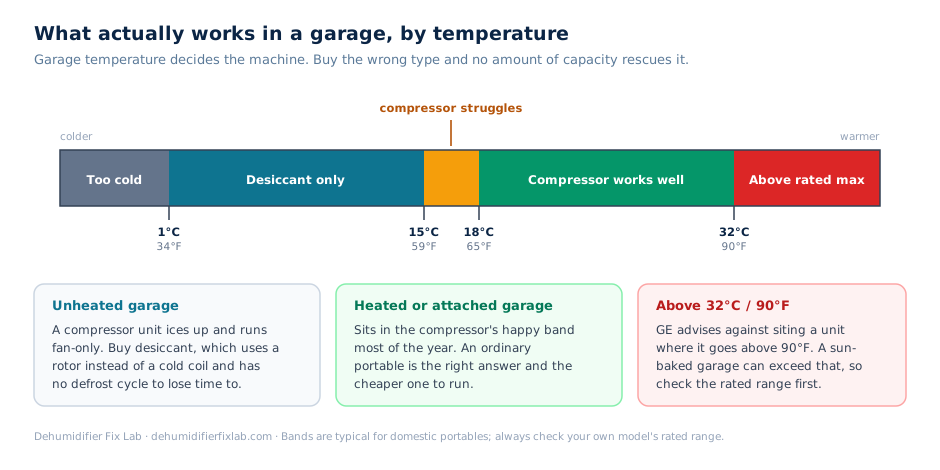
There’s a ceiling too, and almost nobody mentions it. GE’s guidance is not to site a dehumidifier where temperatures go above 90°F / 32°C. A south-facing garage under a metal roof can pass that comfortably in summer, which puts a standard portable outside its rated range at exactly the time you want it working.
2. How often the door opens
A dehumidifier only wins against a closed volume of air. Open the door for five minutes and the garage refills with outdoor air at outdoor humidity, and the machine starts again from scratch.
If you’re in and out several times a day, accept that you’re managing average humidity rather than holding a number. Run the unit continuously on a humidistat rather than in short bursts, and don’t judge it by the reading ten minutes after the door shuts.
If the garage is mostly closed — storage, a workshop you use at weekends, a car that lives there — you’ll hold 50% without much trouble.
What damp actually costs you in there
This is the part that justifies the spend, and it isn’t really about comfort.
- Rust on anything steel. Tools, fixings, the underside of the car, the workbench vice. Surface rust starts well below the point where the air feels damp.
- Mould on stored soft goods. Cardboard boxes, camping gear, fabric, paper. Above 60% relative humidity mould can establish in 24–48 hours on a suitable surface, and the EPA is clear that controlling moisture is the only durable fix.
- Swollen timber and delaminating chipboard on shelving and door frames.
- Corroded electrical contacts on anything stored plugged in.

The target is the same band as the rest of the house: 30–50% relative humidity, which is what ENERGY STAR recommends. Below 30% and timber starts drying out and cracking. There’s no perfect figure, just a band where nothing goes wrong.
Six checks before you buy
Run through these before you spend anything on a dehumidifier for garage use. Three of them cost nothing.
1. Put a hygrometer in there for a fortnight. Read it morning and evening. Garages swing enormously, and one reading tells you nothing. You want to know whether it stays above 60%, not whether it touches it.
2. Take the garage temperature in January, not July. That number decides the machine type. This is the check people skip and then regret.
3. Find the water. A dehumidifier manages humidity; it does not fix a leak. Check the door seal, the junction between slab and wall, and whether the ground outside falls towards the garage. Fixing a failed door seal is cheaper than running a machine against it forever.
4. Deal with the wet car. If a soaking car lives in there, a squeegee and five minutes of door-open time after you park does more than an extra 20 pints of capacity.
5. Work out the volume, not the floor area. Garages have high ceilings relative to their footprint, so square footage understates the air you’re drying.
6. Sort out drainage before you buy. Nobody empties a bucket in a cold garage in February. You want continuous drainage — and if the run passes anywhere that freezes, insulate it or you’ll split the hose.
Choosing a dehumidifier for garage conditions
| Your garage | Buy |
|---|---|
| Attached, heated, stays above 18°C / 65°F | Ordinary compressor portable — cheaper to buy and to run |
| Unheated, drops below 15°C / 59°F in winter | Desiccant. Works down to about 1°C / 34°F, no defrost cycle |
| Unheated but only used in summer | Compressor is fine — just don’t expect winter performance |
| Gets very hot in summer | Check the rated maximum before buying; many stop at 32°C / 90°F |
A desiccant unit costs more to run per litre removed in warm conditions, and it gently warms the space as it works. In a cold garage both of those are features rather than faults.
One thing I’d push back on: the advice to simply buy a bigger compressor unit for a cold garage. Capacity is not the constraint. The coil still freezes. You have bought a larger machine that spends the same proportion of its life defrosting.
Setting it up so it actually performs
- Give it 30 cm / 12 inches clear on every side. Shoved against a wall it re-breathes its own exhaust.
- Keep it off the cold slab — a shelf or a couple of blocks. The floor is the coldest surface in the room.
- Set it to 50% and leave it. Chasing 35% in a garage is a way to spend money without a benefit.
- Run it continuously on the humidistat, not on a timer. It’ll cycle itself.
- Clean the filter monthly. A blocked filter starves the coil, which ices the coil, which is exactly the failure mode you’re already fighting in a cold room.
- Close the loft hatch, seal the gaps, and insulate if you can. Every bit of envelope you close makes the job smaller — and a dehumidifier for garage use is only ever as good as the box you put it in.
Frequently asked questions
Do I really need a dehumidifier in my garage?
Only if the humidity genuinely stays high. Measure for two weeks first. If it sits above 60% for long stretches and you store anything steel, fabric or cardboard in there, yes. If it spikes after rain and settles, ventilation and a door seal may be all you need.
Will a dehumidifier work in an unheated garage in winter?
A compressor one, not really — below about 5°C / 41°F it ices up and runs fan-only. A desiccant unit will, because it uses a moisture-absorbing rotor instead of a cold coil and has no defrost cycle.
What size dehumidifier do I need for a garage?
Work from the volume rather than the floor area, since garage ceilings are high. Then size up a step if the door opens often or a wet car lives in there, because you’re replacing air constantly.
Will a dehumidifier stop my tools rusting?
It will slow it down a lot. Holding the garage at 50% rather than 65–70% is the single most effective thing you can do for stored steel, short of oiling everything.
Does a dehumidifier heat the garage?
A little, yes. Both types put their waste heat back into the room, and desiccant models add a bit more. In a cold garage that’s a small bonus rather than a reason to buy one.
Can I leave a garage dehumidifier running all the time?
Yes, and on a humidistat that’s the right way to do it. It will cycle on and off by itself. Just make sure it’s draining continuously, because a full tank stops the machine and you won’t notice for a week.
Is it worth insulating the garage instead?
If you can, it helps enormously — it steadies the temperature and stops the surfaces getting cold enough to condense on. Insulation and a dehumidifier work together. Insulation alone won’t remove the moisture a wet car brings in.
Related guides: Dehumidifier drain hose: setup and the fall that works · Dehumidifier fan runs but the compressor doesn’t · Attic dehumidifiers: do you need one?
Sources
- GE Appliances — Dehumidifier: Ideal Operating Conditions — the recommendation not to site a unit where temperatures exceed 90°F.
- ENERGY STAR — Dehumidifiers — the 30–50% relative humidity band and sizing guidance.
- US EPA — Mold Course, Chapter 2 — moisture control as the basis of mould control.
Where this guide and your appliance’s own manual disagree, follow the manual. And if you’ve already got a compressor unit sitting in a freezing garage doing nothing — it isn’t broken. It’s just waiting for spring, same as the rest of us.

