
Last Updated on September 1, 2026 by Umar Farooq
A dehumidifier drain hose only works if gravity is on your side. The drain port sits about 10 cm off the floor. Run the hose to a drain at floor level and you have almost no height to play with, so the water sits in the pipe and the bucket starts filling anyway. Raise the unit, keep a steady fall of about ¼ inch per foot, and the whole thing works unattended for months.
That is the entire problem, and it is why most “my dehumidifier won’t drain through the hose” posts are really “my hose is flat” posts. Everything below is the detail.
What you actually need
Not much, and probably less than the accessories page suggested.
- A hose. Most portables take a ¾-inch garden hose thread (GHT) fitting. A short length of ordinary garden hose works; so does purpose-made condensate tubing.
- The rubber washer. It lives in the hose coupling. Missing washer is the single most common cause of a drip at the connection, and people blame the machine.
- Something to stand the unit on. Two concrete blocks, a sturdy crate, a paving slab on bricks. This is the part everyone skips.
- A hose clamp, if your port is a barb rather than a thread.
No tools beyond pliers, really. I’ve never needed anything else for this job.
The one thing that decides whether it works
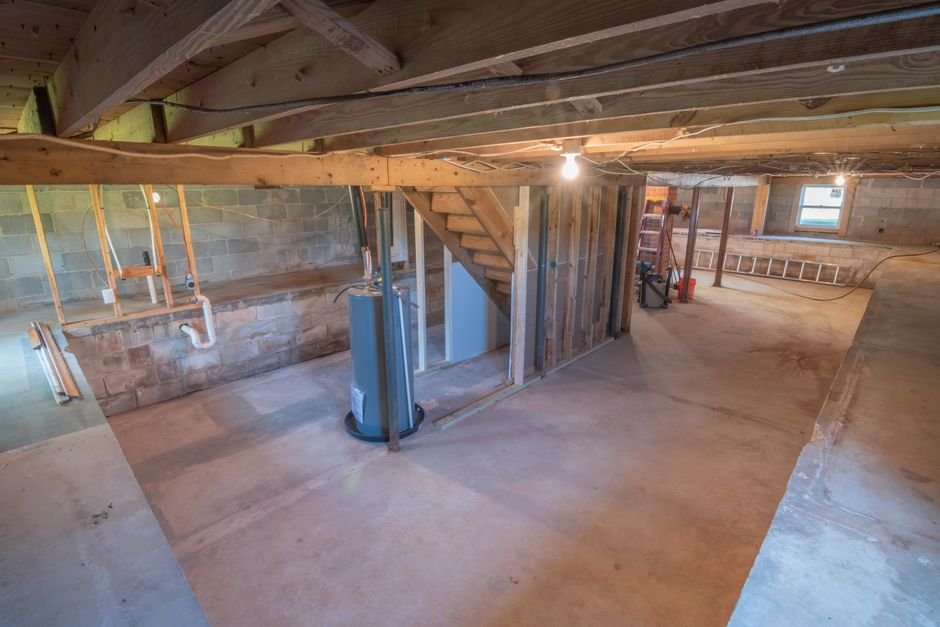
Water does not climb. That sounds obvious written down, and yet the most common continuous-drain setup I see is a machine sitting flat on a basement floor with a hose snaking across to a floor drain in the same slab.
The port on most portable units is only a few inches above the base. The floor drain is in the floor. So the total height you have to work with is whatever the port clears the drain by — often two or three inches over a run of several metres. Add one shallow dip where the hose crosses an uneven bit of concrete and you have made a trap. Water fills the low point, air can’t get past it, and flow stops.
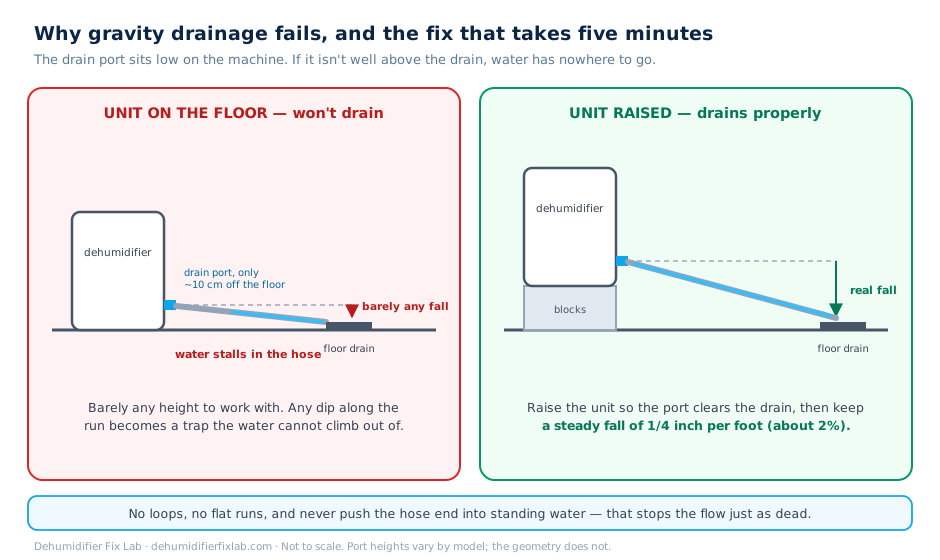
The target is a fall of about ¼ inch per foot — roughly a 2% slope, the same convention used for household waste pipework. Over a 3 metre / 10 foot run that’s about 60 mm / 2.5 inches of drop. Raising the unit 15–20 cm gives you that comfortably.
Worth flagging: you will find guides quoting “¼ inch per 10 feet.” That is a tenfold error and it will not drain. If a number looks like it would fit inside the thickness of your hose, it’s wrong.
Dehumidifier drain hose size and thread: what fits
| What | Typical spec |
|---|---|
| Port thread | ¾-inch female garden hose thread (GHT) on most portables |
| Hose inner diameter | ½ inch minimum; ⅝ inch is better |
| Hose type | Garden hose or condensate tubing — not the thin clear stuff |
| Length | The shortest run that reaches. Every extra metre is more chance of a sag |
The thin flexible tubing that ships in some boxes is the weakest link in the whole system. It kinks if you look at it wrong, and its narrow bore silts up with the sludge that condensate always eventually grows. A ½-inch or larger bore clogs far less readily and is easier to flush.
One thing to check before you buy anything: many units ship with a plug or knockout in the drain port that has to come out before water will pass. GE documents this step for its own models, and the same arrangement turns up across most Midea- and Gree-built machines regardless of the badge on the front.
Setting it up, step by step
- Unplug the unit. Not because this bit is dangerous, but because you’re about to move a machine with water in it.
- Empty the bucket and take it out.
- Find the port and remove the plug. Usually at the rear or side of the base, behind a rubber cap.
- Fit the washer, then the hose. Hand-tight, then a gentle nip with pliers. Over-tightening splits the plastic port, which is not a repairable part.
- Raise the unit on blocks so the port is clearly above the drain — 15–20 cm is plenty for most runs.
- Route the hose downhill the whole way. No coils, no loops, no flat sections. If it has to cross uneven floor, support it so it can’t dip.
- Leave the end above the water line at the drain. Push it down into standing water and back-pressure stops the flow just as effectively as a kink.
- Refit the bucket. On most designs the machine won’t run without it, and it’s your backstop if the hose ever blocks.
- Run it and watch for ten minutes. Check the coupling for drips and the low points for pooling.
Where the water can actually go
You need somewhere below the port that will take a continuous trickle.
- Floor drain. The obvious one, if your basement has it and your slab falls the right way.
- Sump pit. Fine, and usually the easiest in a basement that has one.
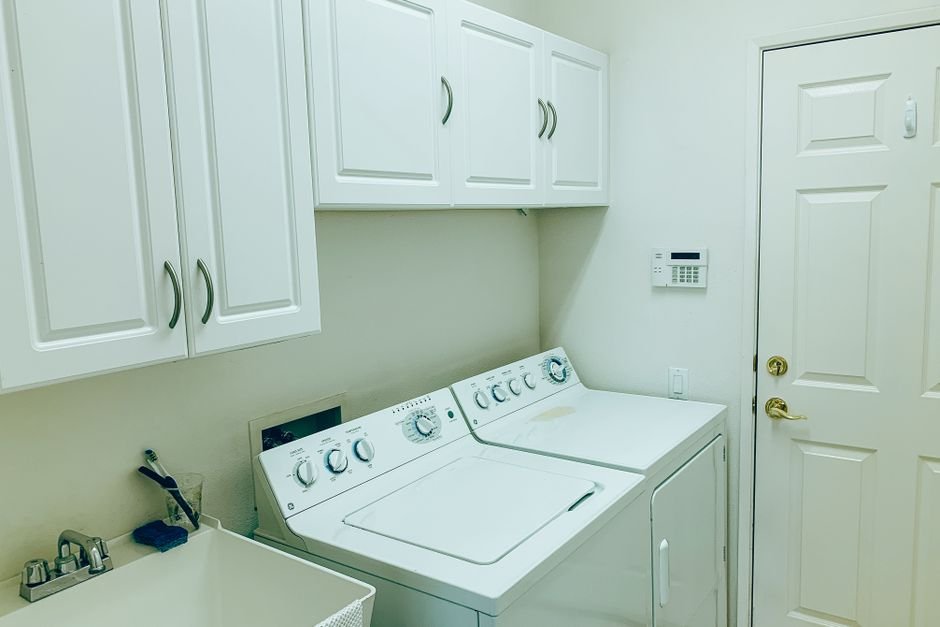
- Utility sink or standpipe. Very common in a laundry or utility room. Hook the hose over the rim rather than into the trap water.
- Outside through a wall. Works, but read the freezing section below before you commit to it.
What does not work: a bucket on the floor (you’ve reinvented the tank, but worse), or a drain that’s higher than the port. If the only outlet is above the machine, gravity is out and you’re into pump territory.
Gravity or pump?
| Gravity drain | Built-in or external pump | |
|---|---|---|
| Needs the drain below the port | Yes | No |
| Typical vertical lift | None — downhill only | Around 10–15 ft, model dependent |
| Failure modes | Sags, clogs, kinks | All of those, plus the pump itself |
| Cost | The price of a hose | A premium on the unit, or a separate pump |
My honest position: use gravity if you possibly can. It has no moving parts, no power draw and nothing to fail. A pump is the right answer when the only drain is a sink above the machine, or when the unit lives in a crawl space or a basement with no floor drain — not as a default upgrade.
If you do run a pump, the discharge line is thin bore and clogs more readily than a gravity hose. Flush it at the start of each season.
When the hose isn’t draining
Work down this list, cheapest first.
- Is there any fall at all? Sight along the hose. If any part of it is level or rising, that’s your answer.
- Is the plug still in the port? It catches people out constantly.
- Is the end submerged? Lift it clear of any standing water at the drain.
- Is the hose kinked behind the unit where you can’t see it?
- Is it clogged? Condensate grows a black biofilm of algae and sludge. Disconnect and flush with clean water; do it every few months.
- Is the washer missing or perished? That causes drips at the coupling rather than a blockage, but people read it as the machine leaking.
Frigidaire’s support article on a unit that won’t drain is worth reading whatever brand you own — the routing rules are identical across platforms, because the platforms are largely identical.
And a connected symptom worth knowing about: when a hose blocks, water backs up into the tank and trips the float. The machine then reports a full bucket that you are looking at, empty, in your hands. If that’s where you are, this is the guide you want — the sensor is doing its job and the drain is the fault.
Freezing, and the split hose nobody warns you about
If any part of the run passes through an unheated space — a garage, a crawl space, an attic, or straight out through a wall — it will freeze in winter. A frozen line backs up, the tank fills, the unit stops, and if you’re unlucky the ice splits the hose and you find out in the spring.
Insulate the line, keep it inside the heated envelope, or accept that continuous drainage is a summer-only arrangement in that location. Below about 5°C / 41°F the machine will be spending most of its time defrosting rather than collecting water anyway, so you lose less than you’d think.
Frequently asked questions
Can I use a normal garden hose for a dehumidifier drain?
Yes, and it’s usually the best option. Most portable units have a ¾-inch garden hose thread port. A garden hose has a wider bore than the tubing supplied in the box, which means it clogs less and flushes more easily.
What size is a dehumidifier drain hose?
The fitting is typically ¾-inch female garden hose thread. For the hose itself, ½-inch inner diameter is the practical minimum and ⅝-inch is better. Anything narrower silts up.
How much slope does a dehumidifier drain hose need?
About ¼ inch per foot — roughly a 2% fall, the same as household waste pipework. Over a 10 foot run that’s around 2.5 inches of drop.
Why is my dehumidifier still filling the bucket with the hose attached?
Almost always because the water can’t get out: no fall, a sag in the run, the port plug still fitted, a kink, a clog, or the hose end sitting in standing water. Water backing up into the tank is the symptom, not the cause.
Do I need to raise my dehumidifier for the drain hose to work?
If your drain is at floor level, yes. The port is only a few inches up, so on the floor you have almost no height to work with. Two concrete blocks solve it.
Does a dehumidifier with a built-in pump drain better?
It drains higher, not better. A pump lets you send water up to a sink or out of a window — typically 10–15 feet of lift. If your drain is already below the machine, gravity does the same job with nothing to go wrong.
How often should I clean the drain hose?
Flush it with clean water every three to six months, and at the start of each season. Condensate is not clean water and the sludge builds up quietly until the day it doesn’t drain.
Related guides: Dehumidifier says the bucket is full when it’s empty · Attic dehumidifiers: do you need one?
Sources
- GE Appliances — Dehumidifier draining options — continuous drain connection and the drain-port plug.
- GE Appliances — Dehumidifier drain hose issues — routing and back-pressure at the outlet.
- Frigidaire — Dehumidifier not draining — hose fall, kinks and submerged outlets.
Where this guide and your appliance’s own manual disagree, follow the manual. And if you’ve already run the hose across a flat floor and it isn’t draining — don’t buy a pump yet. Put the machine on two blocks first and see what happens.

